

Why apply for the Huayu Enrichment Scholarship?

What is the Huayu Enrichment Scholarship?
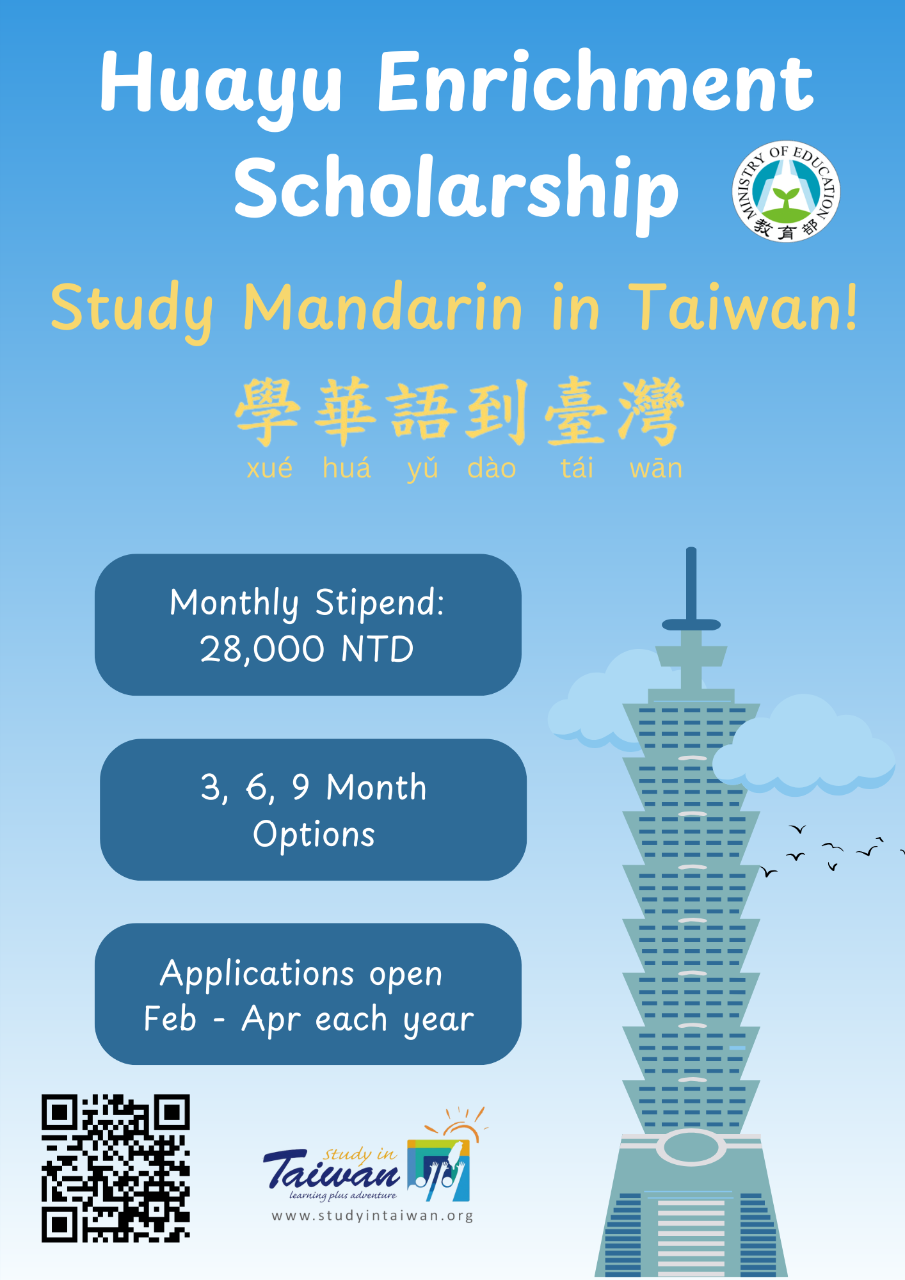
The Huayu Enrichment Scholarship (HES) is the Ministry of Education’s flagship scholarship for studying Mandarin in Taiwan.
The HES provides 28,000 NTD (around $1,400 AUD depending on exchange rate) monthly stipends to help cover tuition and living fees to study Mandarin in Taiwan, with 3-, 6- and 9-month options. With over 60 accredited language centres across Taiwan to choose from, the HES is one of the world’s leading scholarships to study Mandarin.
In Australia, the HES is administered by the Education Division of the Taipei Economic and Cultural Office in Australia, conferring around 50 individual scholarships per year.
If you are a citizen of a country other than Australia, you can visit the website of your local Taipei Economic and Cultural Office to see if they offer Huayu Enrichment Scholarships in your region.
2026 Australia Applications will open 1 Feb 2026. Keep an eye out on the HES page for the application link: https://www.roc-taiwan.org/au_en/cat/21.html
To be eligible to apply, you must meet the following:
- Australian citizen
- Above the age of 18
- Possess a year 12 graduation certificate or above
- Excellent academic performance
- Good moral character
Why apply for the Huayu Enrichment Scholarship?
1: Skyrocket your Mandarin proficiency
First and foremost, the HES is an opportunity to rapidly increase your Mandarin proficiency.
It is widely accepted among linguists that immersion in an environment where the target language is spoken significantly accelerates the process of achieving fluency and is often considered the most effective method of language acquisition.
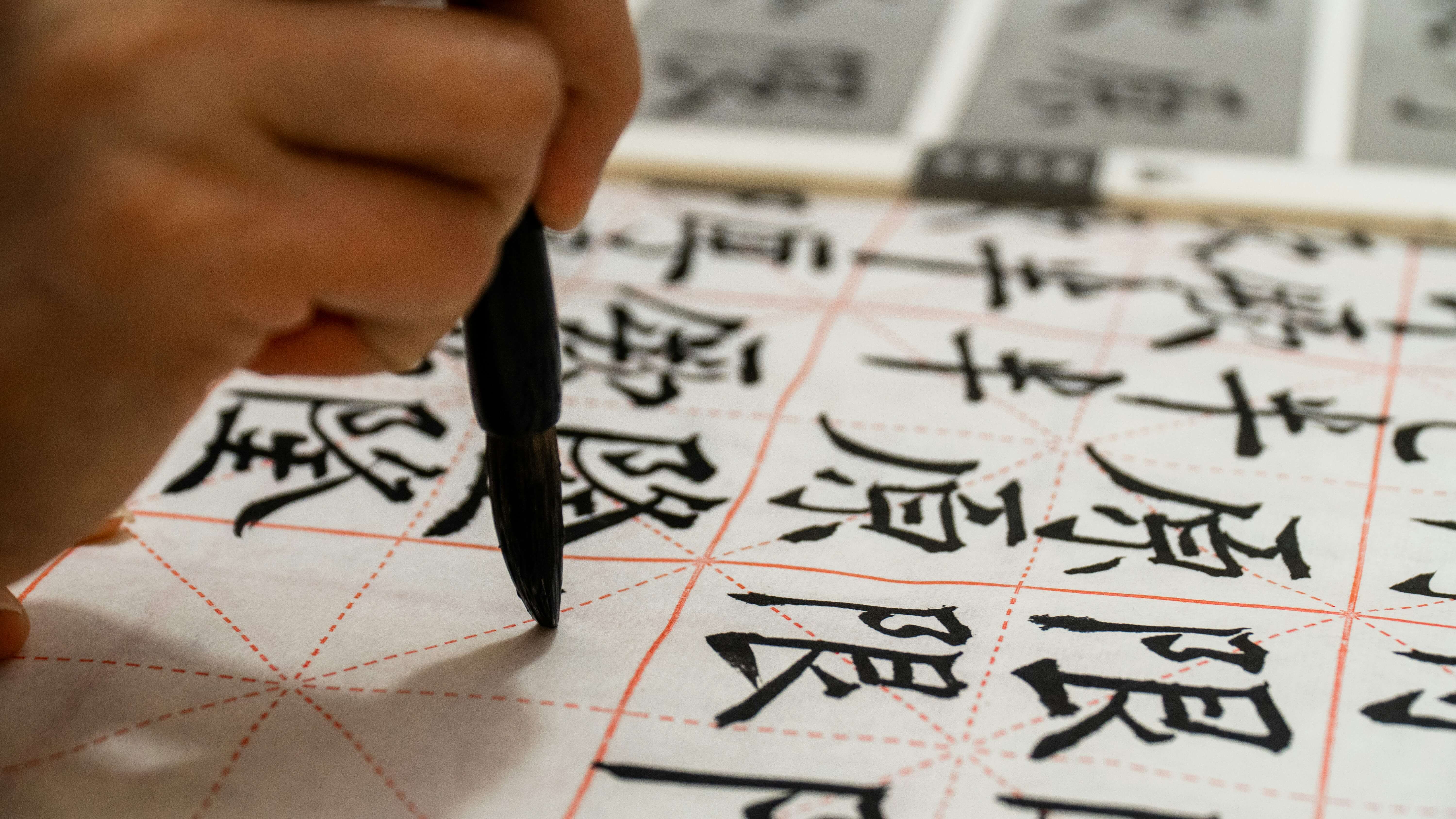
Through the HES, students typically attend at least 2-3 hours of Mandarin classes per day Monday to Friday. These are often supplemented by electives such as conversation practice, calligraphy and Taiwanese culture, which can be optional or compulsory depending on language centre policy.
But the Mandarin learning doesn’t stop when class finishes. Whether you are ordering food, asking for directions, shopping at a night market or chatting with classmates, Mandarin becomes part of your daily life. These constant real-world interactions rapidly improve listening comprehension, pronunciation and confidence, turning passive knowledge into active ability!

2: Learn traditional Chinese characters
Taiwan is one of the only Chinese-speaking regions where traditional characters are still used in official and everyday contexts.
Some beginners are initially apprehensive to learn traditional characters, worrying they are too difficult and wondering whether it’s worth it given simplified characters are more common.
However, traditional characters are nothing to fear; in-fact, they can be a powerful tool to boost your Mandarin to a new level.
Simplified characters are originally derived from traditional characters and are very similar in many cases. By learning a word’s traditional character, you can usually recognise its simplified form with ease (whereas the reverse is not always the case).
For example, with the character to learn (xué), the structure is simplified, but the overall shape and components remain recognisable.
學 → 学
Or with the character for language (yǔ), the speech radical (言 → 讠) is simplified, but the phonetic part remains.
語 → 语
Moreover, by simplifying their radicals, many simplified characters lost some of their intrinsic meaning. Learning traditional characters allows you to better understand a character’s meaning through its radicals.
For example, compare the traditional and simplified version of the Chinese character for love (ài).
愛 → 爱
The traditional character contains components:
- 爫 (claw, hand) — reaching out
- 冖 (cover)
- 心 (heart) — the emotional core
The traditional character literally encodes the idea of something held with the heart and its heart radical clearly shows it is an emotion-related word.
However, in the simplified version, the 心 (heart) radical has been removed. The emotional meaning is no longer visible in the structure of the character and its meaning must be memorised arbitrarily rather than read from its components. Similar examples exist across literally thousands of characters.
3: Wide variety of study destinations
The Huayu Enrichment Scholarship can currently be used at 66 accredited language centres across Taiwan, offering an extraordinary range of study and lifestyle options.
Students can choose to study in major cities with world-class language institutions, such as National Taiwan Normal University and National Taiwan University in Taipei, National Cheng Kung University in Tainan, National Sun Yat-sen University in Kaohsiung and National Taichung Universit of Education in Taichung. These cities offer vibrant urban life, efficient public transport and a wealth of cultural attractions.
Within these cities, there are also smaller and more intimate language centres. These often have fewer international students, providing more opportunities to speak Mandarin with locals while still enjoying big-city convenience.
Alternatively, students may choose to study in smaller cities such as Taoyuan, Hsinchu, Changhua or Pingtung, which have a smaller city feel with fewer foreign students and Mandarin used more consistently in daily life along with dialects like Taiwanese and Hakka.
For those seeking something different, Taiwan’s Eastern Region — including Yilan, Hualien and Taitung — offers breathtaking mountains, rugged coastlines, surf beaches and a slower pace of life, ideal for deep immersion. You can even study on Kinmen Island, rich in history and located just 10 kilometres across the water from Xiamen.

4: Explore Taiwan and make lifelong friends
Beyond language learning, the HES is a gateway to understanding Taiwan’s society, history and culture. Language schools often integrate cultural activities into their programs, from calligraphy and tea ceremonies to local excursions and festivals.
Outside the classroom, weekends and holidays provide endless opportunities to explore Taiwan’s night markets, temples, beaches, mountains and cities. As your Mandarin improves, so does your ability to connect with local people and fully appreciate what you are experiencing.
You will also study alongside students from all over the world who share the same goal — learning Mandarin in Taiwan. These shared experiences naturally create strong friendships, making it easy to travel together, practise Chinese and build an international network that lasts long after the scholarship ends.

Read more about the HES, including requirements, Q&A and in-depth guides on the TECO website: https://www.roc-taiwan.org/au_en/cat/21.html
To keep up to date with all the latest in the Taiwan-Australia education space, sign up to the Study in Taiwan newsletter: https://forms.gle/NK6eX1RkF7J9nP8PA
