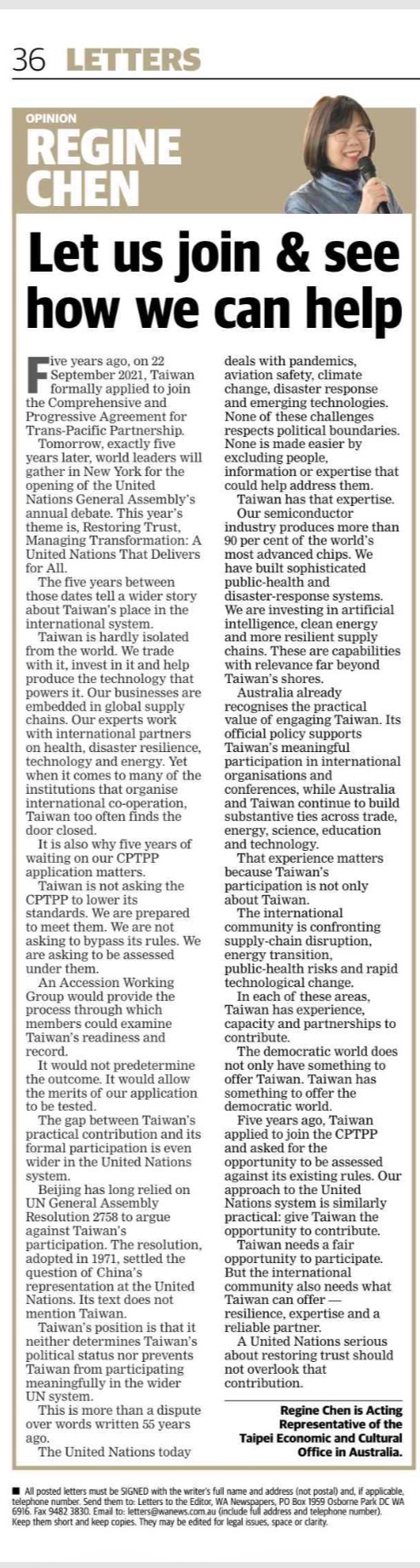
Acting Representative Regine Chen contributed an opinion piece to The West Australian, published on 21 September, titled “Let us join & see how we can help.”
Let us join & see how we can help
Five years ago, on 22 September 2021, Taiwan formally applied to join the Comprehensive and Progressive Agreement for Trans-Pacific Partnership.
Tomorrow, exactly five years later, world leaders will gather in New York for the opening of the United Nations General Assembly’s annual debate. This year’s theme is, Restoring Trust, Managing Transformation: A United Nations That Delivers for All.
The five years between those dates tell a wider story about Taiwan’s place in the international system.
Taiwan is hardly isolated from the world. We trade with it, invest in it and help produce the technology that powers it. Our businesses are embedded in global supply chains. Our experts work with international partners on health, disaster resilience, technology and energy. Yet when it comes to many of the institutions that organise international co-operation, Taiwan too often finds the door closed.
It is also why five years of waiting on our CPTPP application matters.
Taiwan is not asking the CPTPP to lower its standards. We are prepared to meet them. We are not asking to bypass its rules. We are asking to be assessed under them.
An Accession Working Group would provide the process through which members could examine Taiwan’s readiness and record.
It would not predetermine the outcome. It would allow the merits of our application to be tested.
The gap between Taiwan’s practical contribution and its formal participation is even wider in the United Nations system.
Beijing has long relied on UN General Assembly Resolution 2758 to argue against Taiwan’s participation. The resolution, adopted in 1971, settled the question of China’s representation at the United Nations. Its text does not mention Taiwan.
Taiwan’s position is that it neither determines Taiwan’s political status nor prevents Taiwan from participating meaningfully in the wider UN system.
This is more than a dispute over words written 55 years ago.
The United Nations today deals with pandemics, aviation safety, climate change, disaster response and emerging technologies. None of these challenges respects political boundaries. None is made easier by excluding people, information or expertise that could help address them.
Taiwan has that expertise.
Our semiconductor industry produces more than 90 per cent of the world’s most advanced chips. We have built sophisticated public-health and disaster-response systems. We are investing in artificial intelligence, clean energy and more resilient supply chains. These are capabilities with relevance far beyond Taiwan’s shores.
Australia already recognises the practical value of engaging Taiwan. Its official policy supports Taiwan’s meaningful participation in international organisations and conferences, while Australia and Taiwan continue to build substantive ties across trade, energy, science, education and technology.
That experience matters because Taiwan’s participation is not only about Taiwan.
The international community is confronting supply-chain disruption, energy transition, public-health risks and rapid technological change.
In each of these areas, Taiwan has experience, capacity and partnerships to contribute.
The democratic world does not only have something to offer Taiwan. Taiwan has something to offer the democratic world.
Five years ago, Taiwan applied to join the CPTPP and asked for the opportunity to be assessed against its existing rules. Our approach to the United Nations system is similarly practical: give Taiwan the opportunity to contribute.
Taiwan needs a fair opportunity to participate. But the international community also needs what Taiwan can offer — resilience, expertise and a reliable partner.
A United Nations serious about restoring trust should not overlook that contribution.