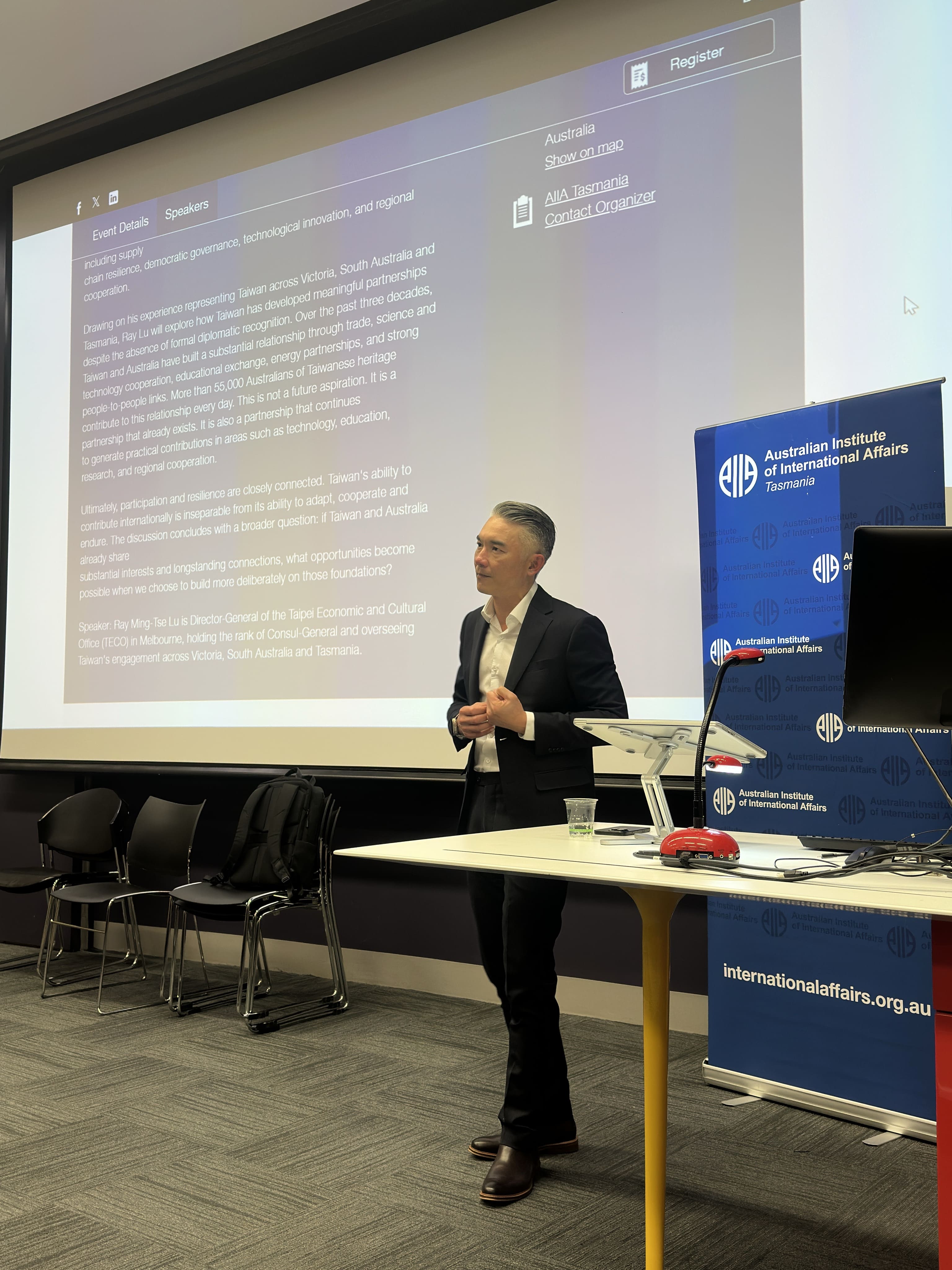
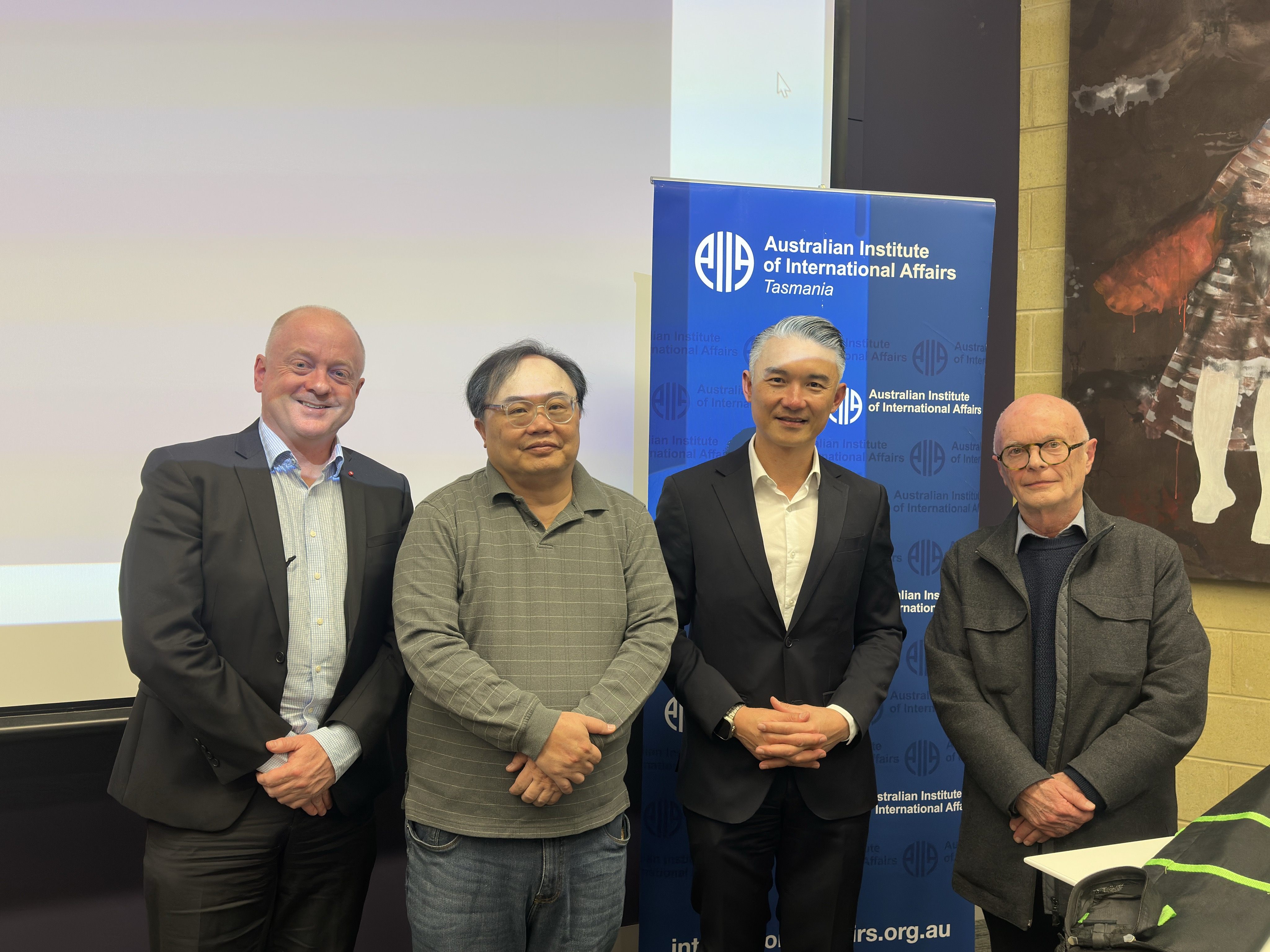
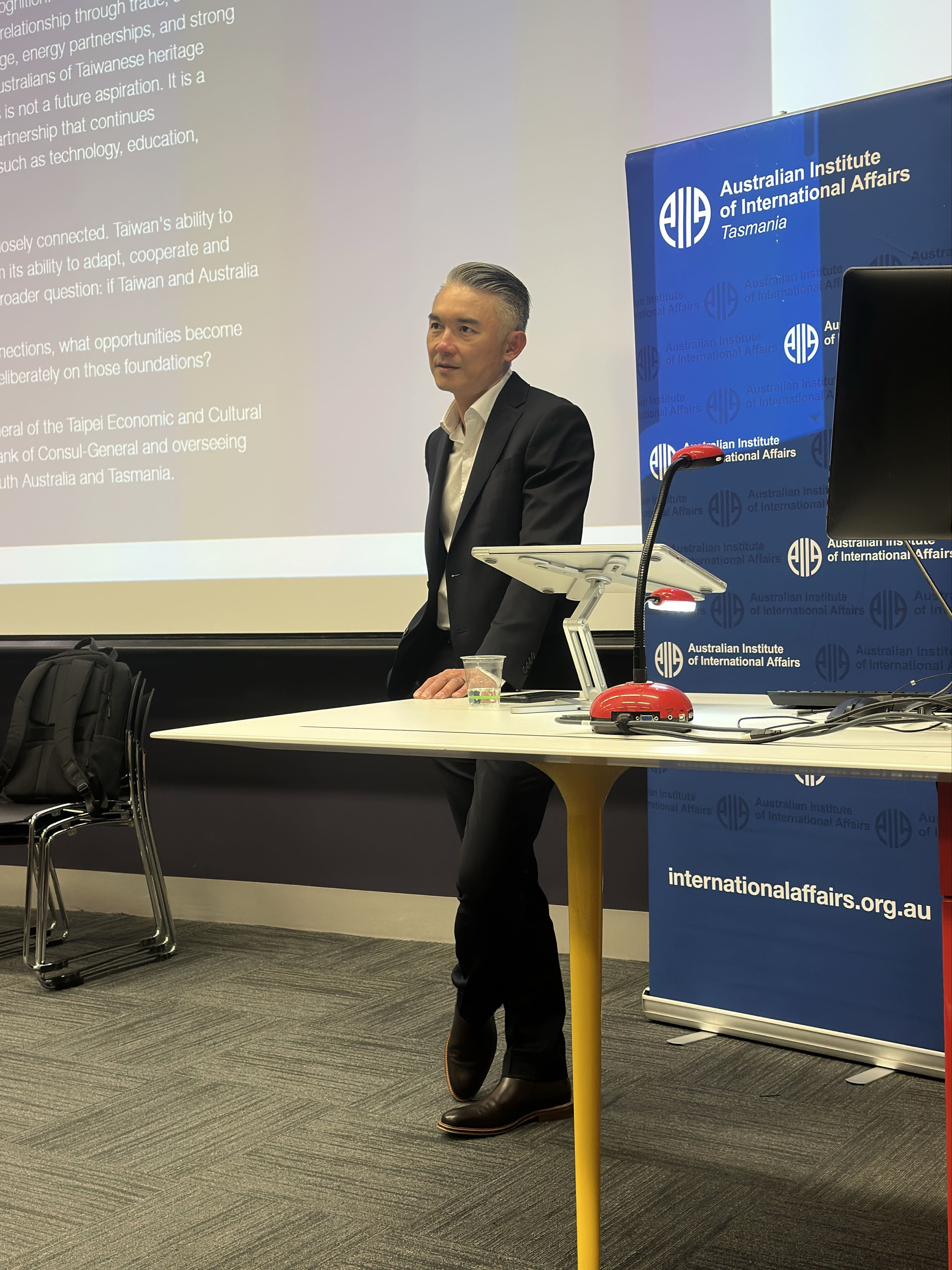
Director-General Ray Ming-tse Lu of the Taipei Economic and Cultural Office in Melbourne was invited by the Australian Institute of International Affairs (AIIA) Tasmania to deliver a keynote speech in Hobart on 5 August entitled How Taiwan Participates: Participation, Resilience and Partnership. He shared Taiwan’s role in the Indo-Pacific and the current state of Taiwan–Australia cooperation with representatives from government, academia and research institutions, followed by an engaging question-and-answer session.
Director-General Lu noted that although Taiwan and Australia do not maintain formal diplomatic relations, the two sides have developed a close and highly complementary partnership. Taiwan is Australia’s 14th largest trading partner in goods and services and its 9th largest export market. As a trusted partner, Taiwan has also attracted A$39.2 billion in Australian investment.
Highlighting Taiwan’s technological strengths, Director-General Lu noted that Taiwan’s semiconductor industry benefits from a complete ecosystem encompassing IC design, manufacturing, packaging and testing, as well as world-class research and talent development. He introduced the concept of “trusted interdependence,” emphasizing that Taiwan–Australia cooperation is not about replicating Taiwan’s industrial model, but about leveraging each other’s comparative strengths to build more secure and resilient supply chains. He also referred to the Taiwan–Australia Science and Technology Arrangement signed in May 2024, which promotes cooperation in ICT manufacturing, semiconductors, critical supply chain resilience, biotechnology and net-zero transition. In addition, the Taipei–Sydney Semiconductor Workshop, launched in 2025, has become an important platform for strengthening bilateral technological exchanges.
Director-General Lu further observed that Australia’s strengths in critical minerals, energy transition, world-class research and trusted institutions complement Taiwan’s advanced manufacturing and technology ecosystem. According to the Tasmanian Government, the state’s mining and mineral processing industry generates nearly A$3 billion annually, while Hobart hosts one of the world’s highest concentrations of Antarctic and Southern Ocean research institutions and expertise. Together with Tasmania’s strengths in mining and renewable energy, these advantages closely align with Taiwan’s development of offshore wind power, green supply chains and advanced manufacturing.
Describing Tasmania as a microcosm of Australia’s broader strengths, Director-General Lu suggested expanding cooperation in areas such as Southern Ocean observation, resilient maritime systems and net-zero critical mineral supply chains, while connecting these initiatives with the existing Taiwan–Australia technology cooperation framework to foster a broader strategic partnership across Australia.
Turning to Taiwan’s international participation, Director-General Lu reiterated that United Nations General Assembly Resolution 2758 addresses only the issue of China’s representation. It neither concerns Taiwan’s sovereignty nor determines Taiwan’s right to participate in the UN system or other international organizations. Excluding Taiwan’s authorities and experts from functional international mechanisms, including civil aviation safety and public health, creates practical governance gaps rather than resolving political differences.
Regarding regional security, Director-General Lu noted that Taiwan continues to strengthen its self-defence capabilities and whole-of-society resilience to ensure the continued functioning of energy, communications, healthcare, transportation and democratic institutions under pressure. Taiwan remains committed to maintaining the status quo across the Taiwan Strait and welcomes rational dialogue with all parties on the basis of equality and dignity.
Director-General Lu concluded by emphasizing that formal diplomatic relations are by no means the only measure of the depth of a partnership. The longstanding foundation of Taiwan–Australia cooperation in trade, technology, research, education and people-to-people exchanges provides the strongest basis for future collaboration. He expressed his hope that through continued practical cooperation, this partnership will extend further into Tasmania and communities across Australia.