

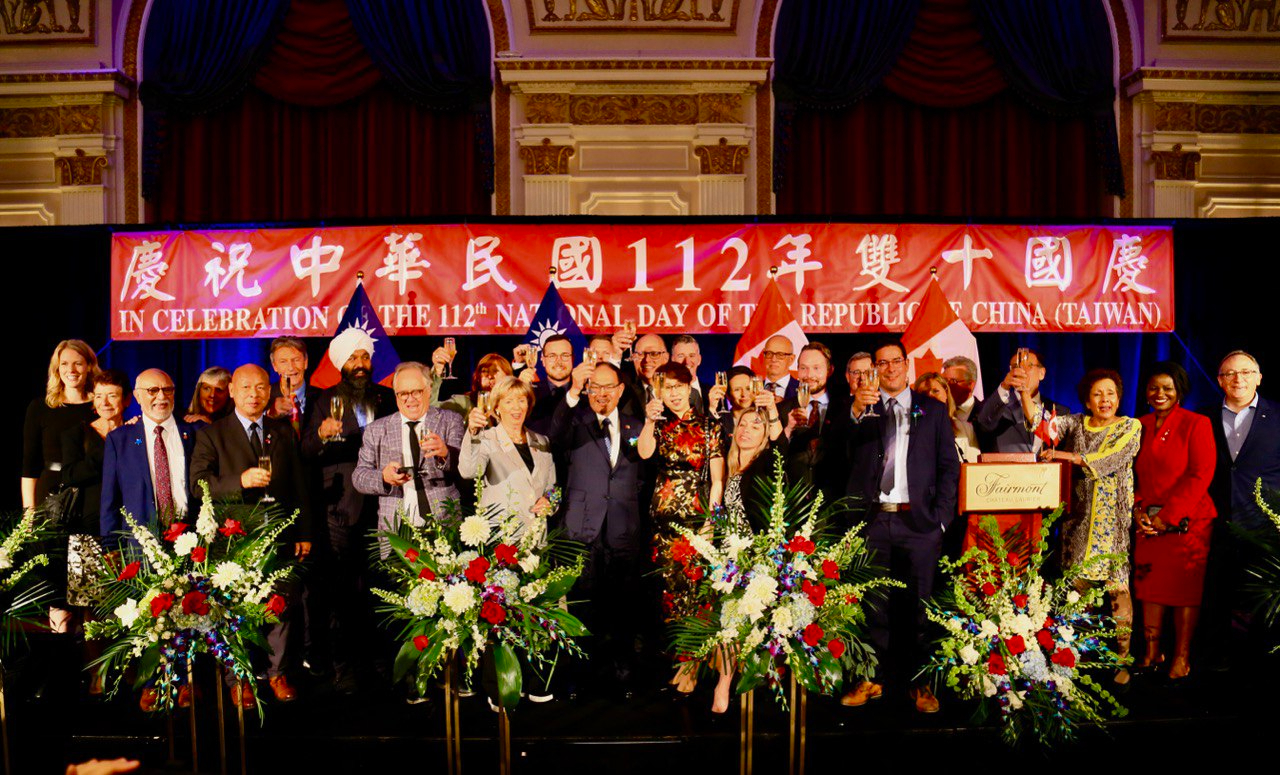
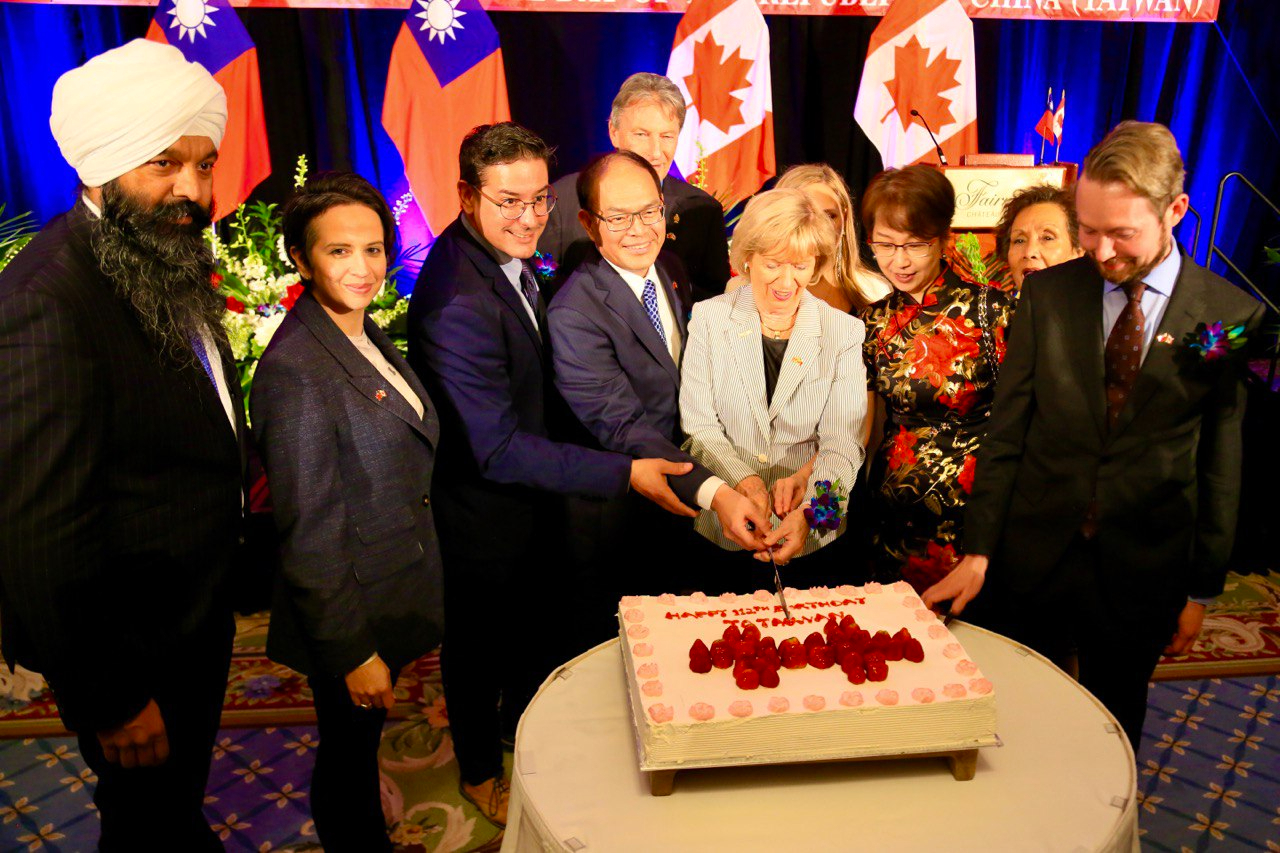
On October 4th, Ambassador Harry Ho-jen Tseng, Representative of the Taipei Economic and Cultural Office in Canada and Madam Hui-Ling Lu hosted a reception in celebration of the 112th National Day of the Republic of China (Taiwan).
The event was held at the historic Fairmont Château Laurier in Ottawa and was attended by a diverse audience, including Canadian officials, members of the political, academic, business, technology, journalism, and diplomatic communities. The gathering attracted over 300 guests in total.
Notably, nearly 80 bipartisan members of parliament were present, including Robert Oliphant, Parliamentary Secretary to the Minister of Foreign Affairs; Paul Chiang, Parliamentary Secretary to the Minister of Immigration, Refugees and Citizenship; Ali Ehsassi, Chair of the House of Commons Standing Committee on Foreign Affairs and International Development; John McKay, Chair of the House of Commons Standing Committee on National Defence; Judy Sgro, the Chair of the Canada-Taiwan Parliamentary Friendship Group; Senator Michael MacDonald, Co-Chair of the Canada-Taiwan Parliamentary Friendship Group; Melissa Lantsman, Deputy Leader of the Conservative Party; and Jenny Kwan, Caucus Chair of New Democratic Party.
On the evening, the reception was kicked off with the vibrant sounds of drums and a performance by the Success Dragon Lion Dance Troupe and Taiwanese “Electric Three Prince” (Techno Santaizi.) Ambassador Tseng gave the opening remarks after the energetic performances and the singing of national anthems.
He expressed gratitude to all those in attendance for joining the annual celebration that brings together compatriots from home and abroad. He also noted that Taiwan, “as a litmus test to determine the resilience of democracies around the world,” faces more critical circumstances than ever before.
“China’s President Xi is hell-bent on achieving what he sees as ‘reunification’ with Taiwan,” said Tseng and continued, while upholding the possibility of peaceful unification under the formula of “one country, two systems,” Xi has not ruled out the potential use of military force to reclaim Taiwan.
Learning from the lesson of Hong Kong, which served as a testing ground for the formula, it is clear that, “there is only one system in China, an authoritarian system, Hong Kong included,” Tseng underscored.
Ambassador Tseng further emphasized the reason why Taiwan is worth protecting.
From an economic perspective, Taiwan's manufacturing prowess and its vital role in global supply chains are noteworthy. It manufactures more than 90% of the world’s advanced semiconductors and holds a market share of over 50% in foundry operations, packaging, and testing worldwide.
“But the simple answer is this: because Taiwan is worth protecting,” Ambassador Tseng hailed. “It’s worth protecting for its hard-won freedoms and democracy. It’s worth protecting as proof that it is possible to come through the darkness of an authoritarian past, to reflect and to grow into a genuine democracy.”
He concluded his remarked by urging the crowd to use voice they possess to speak up for Taiwan.
“Taiwan’s freedoms, its democracy, its way of life and its sovereignty must be cherished and defended. Our future, the future of liberal democracy in general, may just depend upon it.”
MP Judy Sgro, along with representatives from various major political parties including MP Michael Cooper who read aloud remarks of MP Pierre Poilievre, MP Alexis Brunelle-Duceppe, MP Lindsay Mathyssen, and Sen. Michael MacDonald delivered speeches to congratulate the event.
In their speeches, the parliamentarians emphasized their commitment to advancing relevant legislation in Parliament to strengthen economic, cultural, and legal cooperation between Taiwan and Canada. They also pledged to urge the Canadian government to support Taiwan’s participation in multilateral organizations, such as CPTPP and WHO.
