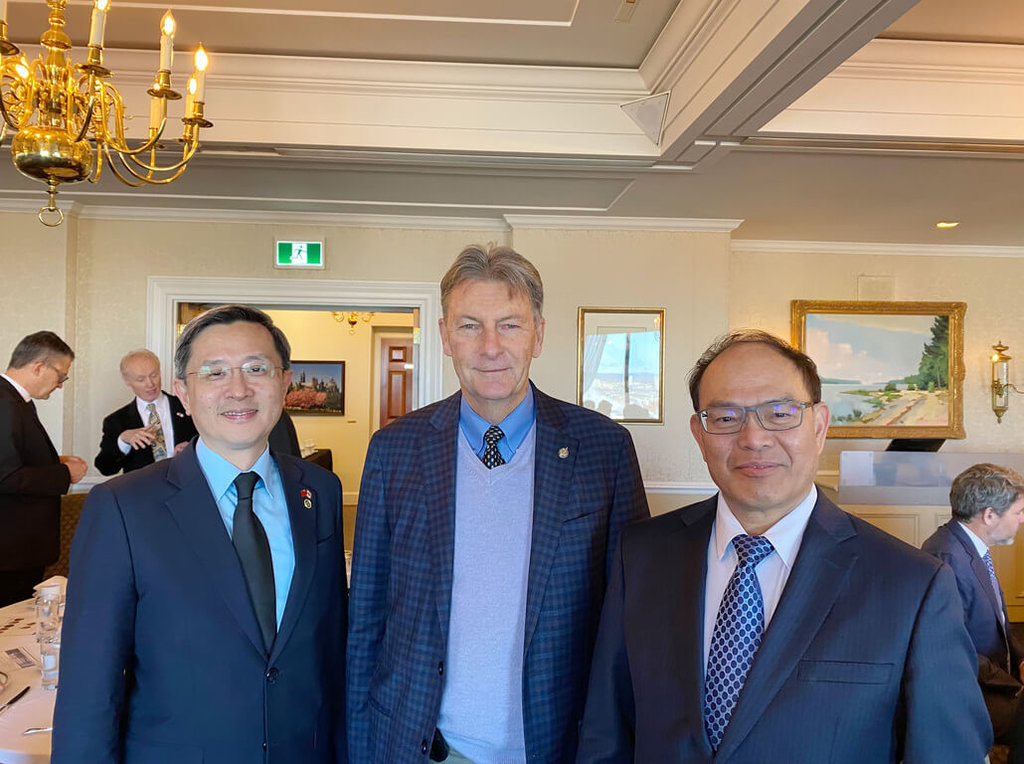
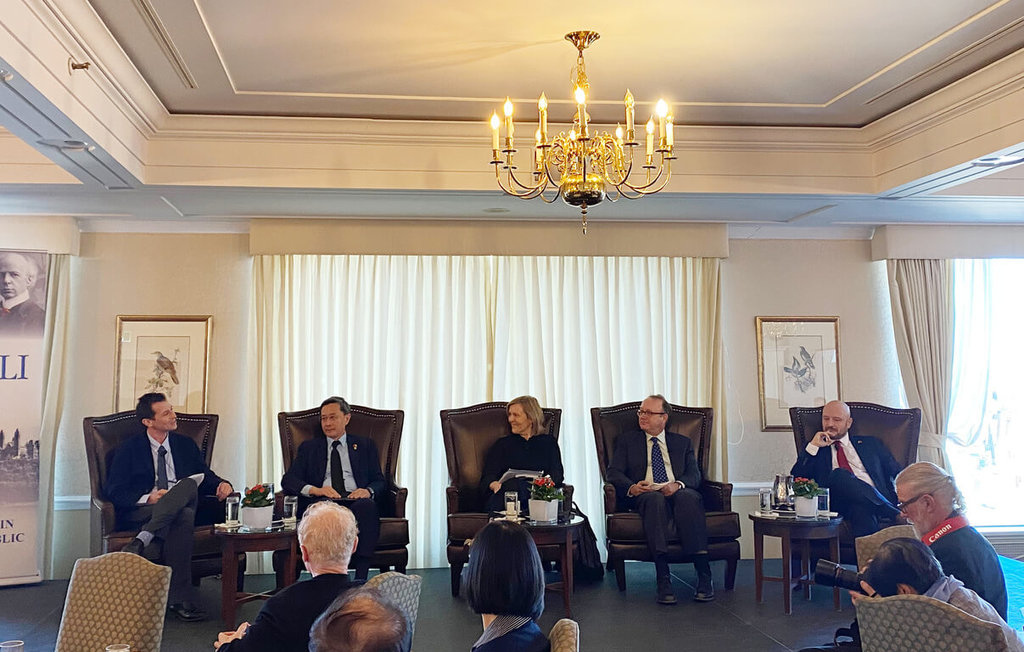
On November 17-18, the MacDonald-Laurier Institute (MLI), a Canadian think tank, held a seminar titled "Democracy Fortress: Defending Taiwan in the Face of China's Rise." Lee Chun, Deputy Minister of Foreign Affairs, was invited to deliver a speech on "Amidst geopolitical turbulence, forging partnership and peace." He discussed Taiwan's efforts to enhance its defense capabilities in the face of continued military activities by the Chinese People's Liberation Army in the Taiwan Strait and South China Sea. Lee emphasized that China's ambitions extend beyond Taiwan, aiming to shape a global environment favorable to authoritarian regimes through various gray-zone tactics.
Lee Chun highlighted the importance of Taiwan's partnerships with like-minded nations, expressing gratitude for Canada's recent support, exemplified by the completion of negotiations for the Taiwan-Canada Foreign Investment Promotion and Protection Agreement (FIPA). Kerry-Lynn S. Nankivell, Director of Strategic Assessments at the Canadian Department of National Defence, affirmed Canada's interest in prosperity and stability in the Indo-Pacific, emphasizing the country's commitment to maintaining regional security. Despite China's interference with military vessels and aircraft, Canada remains resolute in safeguarding the security of the Indo-Pacific region.
Scott Simon, Senior Research Fellow at MLI and professor at the University of Ottawa, pointed out China's use of cyber warfare and the dissemination of false information, leading many in Taiwan to believe in the decline of the West and consider compromising with Beijing. Simon urged Canada to openly support Taiwan, demonstrating solidarity within the democratic camp.
Experts in the discussion also highlighted that a crisis in the Taiwan Strait might not necessarily manifest as a large-scale armed conflict. Balkan Devlen, Senior Research Fellow and Director of Transatlantic Relations at MLI, suggested that Canada should collaborate with other nations to provide practical assistance, such as strategic planning for the transport of energy and food supplies to Taiwan. This proactive approach would prevent difficulties in resource delivery during a crisis.
The seminar attracted nearly a hundred participants from academia and the overseas Taiwanese community. Notable attendees included John McKay, Chair of the Canadian House of Commons Standing Committee on National Defence, Richard Fadden, former National Security Advisor to the Canadian Prime Minister, Darius Skusevicius, Ambassador of Lithuania to Canada, Chris Smith, U.S. Political Counselor, Tokuro Fukuyama, Minister at the Embassy of Japan in Canada, and Hou-Jen Tseng, Representative of the Taipei Economic and Cultural Office in Canada. The event fostered lively discussions and exchanges among participants.