

Looking to provide students at the University of Alberta with an opportunity to understand the context behind Taiwan’s unique political and economic position, Professor Ashley Esarey, director of the Taiwan Studies Program at the University of Alberta, had invited Director General Lihsin Liu of the Taipei Economic and Cultural Office in Vancouver to a virtual session with students on February 7, 2022.
The session was conducted in a format of questions and answers, at which Director General Liu shared her personal experience as a career diplomat for Taiwan in the last 22 years. It lasted around an hour, and students had responded positively and frankly. Here is the summary of the QA session:
What is it like to work as a diplomat for a polity that doesn’t have official recognition by most major countries and international organizations? How does your work compare to that of diplomats serving other countries?
Due to China’s boycott of Taiwan’s diplomatic relations and international participation, we have to work double or triple times harder than other country’s diplomats. When official channels do not work, or take longer time to work out the result we hope, we cooperate with NGOs, or overseas Taiwanese community to send our messages to the Government that we are stationed at.
We just don’t enjoy the full access or privilege that other country’s diplomats have, and we have to maintain official channel so as to manage the substantial relations that we still have with all the countries due to Taiwan’s strong economic and people to people relations with these countries.
Take Canada as an example, the government has not sent a “minister” to Taiwan for over 40 years. But we are glad to learn that our trade ministers conducted a virtual talk on exploratory discussion on bilateral Foreign Investment Promotion and Protection Arrangement (FIPA) to further our bilateral investment prospective.
What are the largest concerns for Taiwan in international relations presently?
Taiwan’s largest concern is Communist Chinese Government, not China or Chinese people. The core issue is that we consider Taiwan as a sovereign state, while the PRC’s one China principle, or its one Country Two Systems formula, upholds that there’s only one Chine in the world, and that is the PRC.
The PRC government continues to take all actions to weaken Taiwanese people’s trust on the Taiwan government, which includes taking away our diplomatic allies.
It also forced international businesses which operate in China to change Taiwan’s name as a province of China on their websites. Air Canada is one of the examples. It downgrades Lithuania’s Embassy in Beijing from Ambassador to Attache level, and Lithuania’s rum and beers were prohibited from exporting into China after Lithuania allows us to establish a Taiwan Representative Office in its capital Velnius.
The isolation of Taiwan by multilateral organizations also led to adverse consequences impacting the entire world. The most obvious example is the World Health Organization’s ineffective response to Taiwan’s timely notification about transmissibility of COVID-19 between people at the end of 2019.
There is a lot of speculation about the possibility of a Chinese invasion of Taiwan in the future. What has Taiwan done to prepare for this?
Facing with a rising military power such as PRC, not only have we increased our military spending on purchasing defensive weapons from the US, but also enhanced our national defense capacity by making our own indigenous submarines, and aircrafts.
Enhancement of our asymmetric warfare capacity is important as we face such a country that is militarily much more powerful than us, and it is an aggressive authoritarian country across the Taiwan Strait.
Since last year our Ministry of National Defense has updated PLA’s activities over its official twitter so as to make the aggressive activities known to the public and the international society, especially the US, Japan and like-minded countries in the area which are capable and may be willing to help Taiwan defend ourselves. International Society has responded to this tension across the Taiwan Strait with solemn concern, multiple high-level leaders or minister’s meetings have concluded with a joint statement at which concern over the security and safety in the Taiwan Strait is expressed. The most recent ones are Australia-British 2+2 meeting and US-Japan leader’s meeting on January 21. Overall, the US, Japan, Australia, G7 countries including Canada and EU have openly expressed their concern over Chinese coercive actions toward Taiwan.
During the pandemic many major economies have faced economic downturns, while Taiwan’s economy has continued to grow at an impressive pace. To what do you attribute Taiwan’s remarkable success?
Taiwan enjoyed a 6.1% economic growth last year, and this growth was attributed to Taiwanese prowess in the semiconductor and information technology sector. Apart from rising global demand for Taiwanese technology, US market trends have also led to a steady and resurging interest for traditional Taiwanese plastics, textiles, chemicals, and metals.
With the pandemic, the rising US-PRC trade tensions, and the structural changes in the Chinese economy and geopolitics, Taiwan has been gradually minimizing its investment in the Chinese market since 2010, by diversifying its investment portfolio across Southeast Asia. These steps have played an important role in Taiwan’s economic success.
Our class has touched upon various aspects of Taiwan’s history and democratization, including the five-decade period of Japanese colonial rule. What is Taiwan’s relationship with Japan like these days?
The first development I would like to highlight relates to the remarkable “mainstreaming” in Japan of concerns about peace and stability in the Taiwan Strait, especially after the April summit between President Joe Biden and then Prime Minister Yoshihide Suga last year.
Beyond security issues, in 2021 Japan’s government again express support for democratic Taiwan as “an extremely crucial partner and an important friend, with which Japan shares fundamental values,” and supports our application for membership in CPTPP and observer status at the WHA. Japan’s government also continued its formal membership in the U.S. and Taiwan-led GCTF (Global Cooperation and Training Framework).
The last development from 2021 to be highlighted here is the continued deepening of politician-centered initiatives. Since Japan-Taiwan diplomatic relations ended in 1972, legislative exchanges have been the primary venue for political exchange and cooperation. For example, last February, Japan’s most powerful political party, the Liberal Democratic Party (LDP), launched its first-ever Taiwan-focused “Project Team.
Living in a country that is warm (by Canadian standards) Taiwanese are unsurprisingly not that into winter sports. There is rarely frost or snow, except in the high mountains; Taiwan doesn't have active ski resorts. Yet the country has agreed to send a small delegation to the Beijing Winter Olympics. Who are Taiwan’s athletes? What events are they competing in? What is it like for them to compete on behalf of “Chinese Taipei,” as Taiwan (or the ROC) is called, based on a 1970s agreement with the IOC. What has been the nature of considerations about whether to send athletes to the 2022 Beijing Winter Olympics?
Taiwan this time sends four athletes to Beijing, the same number as the last winter Games in 2018 in Korea. Two for Alpine skiing(何秉叡, 李玟儀), one for single Luge(林欣蓉), and one for speed skating(黃郁婷).
Taiwan government is committed to ensuring that Taiwan's athletes can compete at the Winter Olympics because they have put a lot of hard work and preparation into it. Taiwanese athletes completed their participation in the 2020 Tokyo Olympics with a record-breaking number of medals- two golds, four silvers and six bronzes, the best ever in history. We want to make sure Taiwan’s delegation would not belittle itself at the Beijing Olympics.
Finally, to answer a question posed by students, Director General Liu emphasized that Beijing’s attempts to constrict Taiwan’s space on the international stage and alter Taiwan’s status by non-peaceable means will only push the Taiwanese people further away. Even in the face of such pressure, countries sharing the same values as Taiwan, like Canada, can still support Taiwan in many ways, from deepening two-way trade and cooperation in clean energy, to continuing discussions on the possibility of reaching a mutually-beneficial Foreign Investment Promotion and Protection Arrangement (FIPA) that have recently begun.
The University of Alberta has worked together with the Ministry of Foreign Affairs of the Republic of China (Taiwan) to roll out the University’s Taiwan Studies Program in 2020, as part of a common effort to enrich studies of Taiwan at the post-secondary level, and support a new generation of Taiwanese experts in Canada. To date, the program has enrolled 42 students.
Live Stream recorded on YouTube: https://youtu.be/v3RWIafKTak
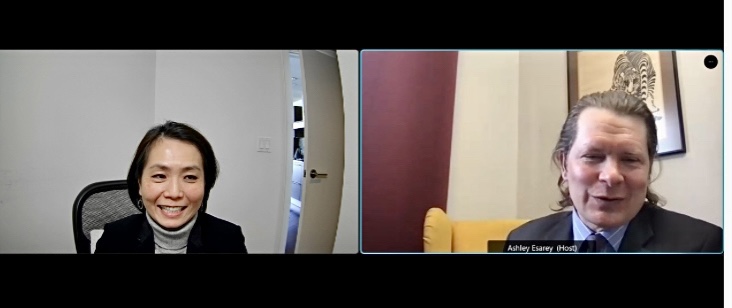
Director General Liu had a virtual QA session with Dr. Ahsley Esarey, Director of The Taiwan Studies Program at University of Alberta, and his class on February 7, 2022
