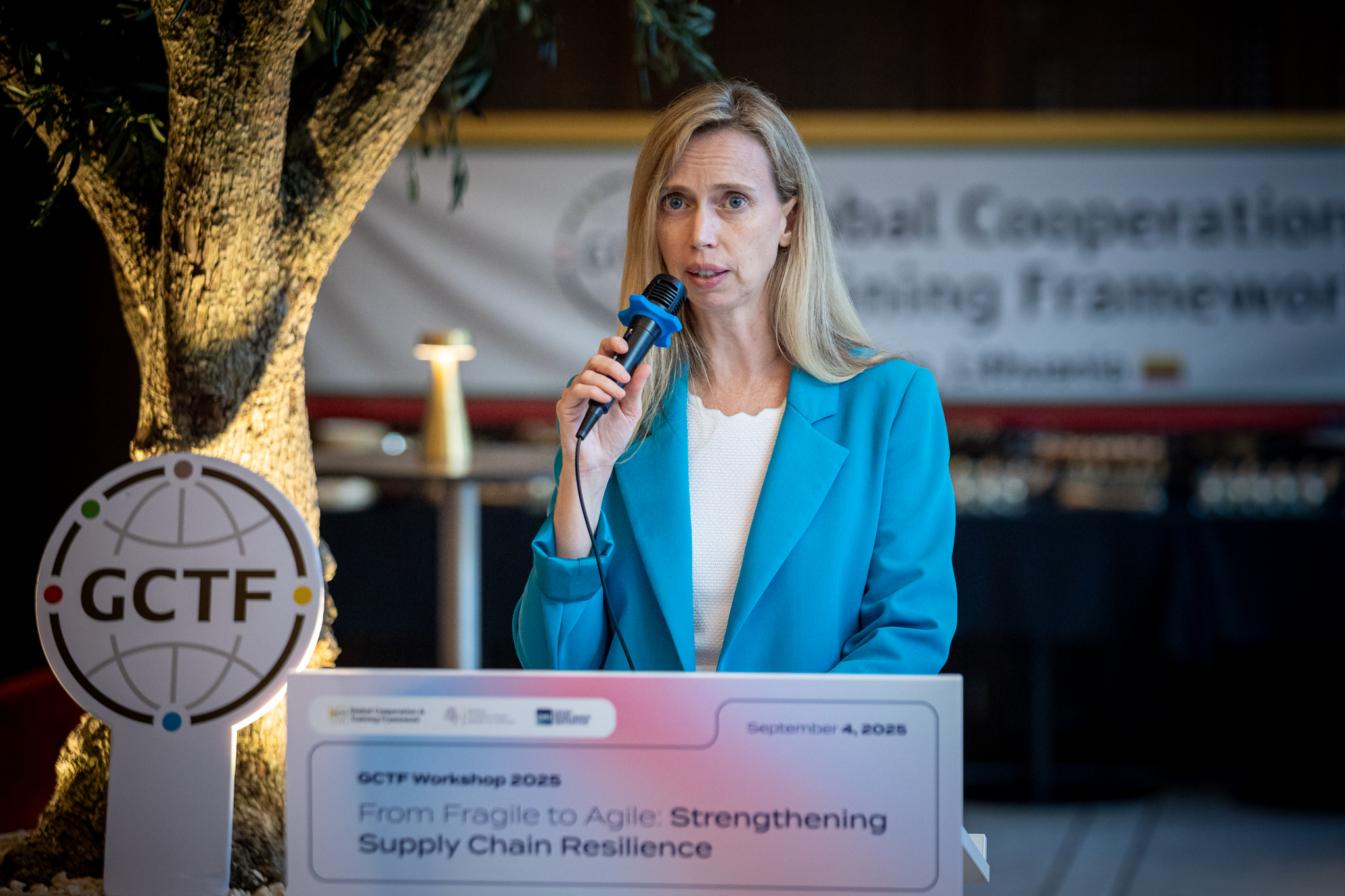
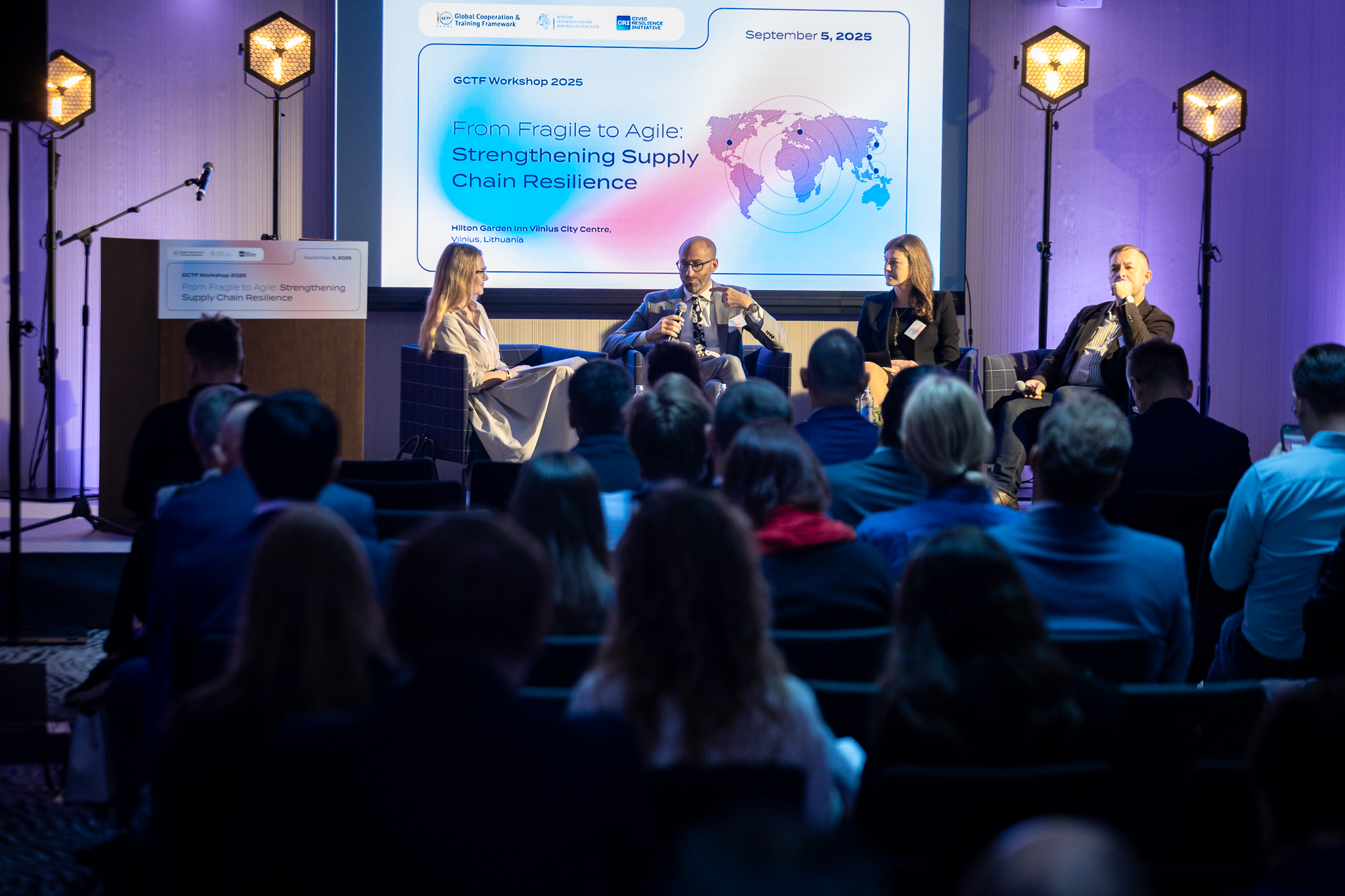
Building on the success of last year’s event, the Lithuanian Ministry of Foreign Affairs, The Taiwanese Representative office in Lithuania, the Embassy of the United States in Lithuania, and the NGO Civic Resilience Initiative co-hosted the Global Cooperation and Training Framework (GCTF) Workshop, with this year’s focus on Strengthening Supply Chain Resilience in Vilnius.
The workshop brought together distinguished speakers from government, academia, and industry, including representatives from the United States, Taiwan, Japan, Lithuania, and despite the geographical distance, from the Republic of Palau. Panel discussions addressed the urgent need to foster economic resilience in times of geopolitical tension, under themes such as “Building Economic Resilience: Rethinking Supply Chains in a Fragmented World,” “Tech-Driven Resilience: Leveraging Innovation for Supply Chain Agility,” and “Mobilizing Public-Private Partnerships for Systemic Resilience.” The Minister of Justice of Palau, Jennifer Olegeriil, was invited to Lithuania to deliver a keynote address, sharing her country’s experience in countering economic coercion. This also marked the first-ever visit to Lithuania by a Minister from Palau.
"This experience has become our national competence," said Vice Minister Julius Pranevičius of the Ministry of Foreign Affairs – I think this is a contribution that our partners in the EU, the US, and the Indo-Pacific value, as we all work together to shape a new architecture for collective resilience. One of the main lessons for us is this: supply chain resilience is built not only domestically, but also through partnerships.”
Ambassador McDonald emphasized the critical importance of supply chain resilience to shared security and prosperity. She called for actionable solutions to diversify supply chains, leverage technology, and deepen cooperation among trusted partners to ensure secure, sustainable, and agile supply chains.
In her remarks, Representative Constance Wang of the Taiwanese Representative Office stressed that economic coercion poses major challenges to democracies, making closer cooperation on supply chain resilience essential. She added that Taiwan stands ready to share its frontline experience to help build more resilient societies.
“At Civic Resilience Initiative, resilience has always been at the heart of our mission – from countering disinformation to strengthening democratic societies. Today we turn our focus to another critical challenge: building secure and resilient supply chains, which are not only an economic issue but a cornerstone of security and strategic stability. In the face of global disruptions, international cooperation is essential to ensure that our supply chains remain strong and future-proof. Lithuania’s shared experience with Taiwan demonstrates how like-minded partners can work together to turn challenges into opportunities for greater resilience,” said Tomas Kazulėnas, CRI Co-Founder and Director.
Established in 2015 by Taiwan and the United States, under the auspices of AIT and TECRO, and later joined by Japan, Australia, and Canada the Global Cooperation and Training Framework (GCTF) has become a key platform for international capacity building. Since 2021, it has expanded overseas, with this workshop marking the second GCTF event in Lithuania.