


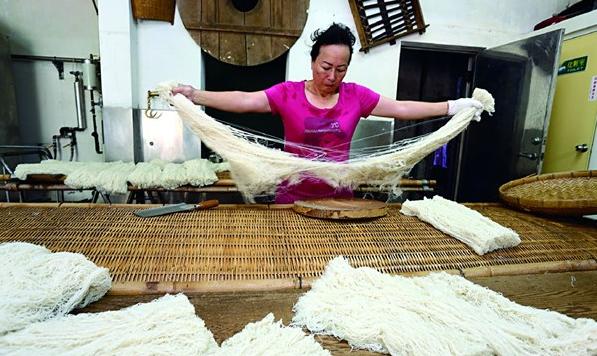
 The rice-flour dough is pressed through holes into long skeins, which are placed in steamers before finally being separated to cool. Making dry rice vermicelli is a long, involved process.
The Chinese have thousands of years of history with a rice-based cuisine. The wisdom of our ancestors, in accordance with the turning of the seasons and a love of the land, developed an agricultural culture of “planting in the spring, weeding in the summer, harvesting in the fall, and storing in the winter.”
Today that legacy has evolved into all manner of culinary delicacies, which are invested with a variety of deep meanings for ethnic Chinese. These dishes play an important role in major occasions and festivals and are used as offerings for the worship of ancestors, land gods and Daoist deities. Rice not only bears great culinary importance, but it has also become a symbol of how Chinese culture is rooted in the land.
Before even four in the morning, the rice milling machines at Hsinchu’s Dongdecheng Rice Noodle Factory are clanging away. Previously, indica rice that had been soaking for more than eight hours was poured into upright milling machines. From these, white rice milk is now oozing. This is the start of the process for making many traditional rice foods.
The third-generation owner Guo Lianjin first pours thick white rice milk into a cotton bag and then squeezes out the liquid, leaving only the wet rice paste. He then puts that into a steamer to create a half-cooked sticky clump, which his wife Lin Meijin puts into a mixer to achieve an even consistency. It is rolled twice to achieve an even flat shape and finally pressed through fine copper holes to become strands of fresh “wet” rice vermicelli.
A deliciously local tangle
To create dry vermicelli, these wet vermicelli have to be steamed in a steamer to become what is called chuifen. When Guo Chunxian, a fourth-generation member of this family firm, pulls out the chuifen from numerous steamers, the factory instantly turns into a steam room. The female family members working in the old factory show no fear of scalding themselves as they shake out the skeins of chuifen, exposing them to the air to cool them as quickly as possible. On the day we visited it was a scorching summer day and 37°C outside. The temperature inside was likely in the 40s or 50s. This stage of the work can’t be replaced by machines. The women must work fast to make sure that the hot chuifen that has just left the steamers doesn’t ferment and go bad. Only when it has cooled sufficiently can they commence the stage of sun drying that creates dry vermicelli.
Hsinchu rice vermicelli have long been made this way, and this old firm, which dates back to the Japanese era, insists on following the traditional methods. The machines in the factory are also over 100 years old and are quite rare objects themselves.
For every 100 catties (60 kilograms) of rice, you can only create 60 catties of dry vermicelli, or 130 catties of wet vermicelli. The Dongdecheng Rice Noodle Factory can only produce 200-some catties of wet vermicelli per day. That limited amount is snatched up by local noodle shops virtually moments after leaving the steamers. Guo Lianjin, the factory’s owner, says “We insist on using one-year-old indica rice. Pure rice vermicelli best suit the tastes of Taiwanese. Even if you eat a lot, you won’t get indigestion. We’ve maintained the methods and scale of a family operation to the present day, so customers must book ahead of time for vermicelli at New Year’s. We can’t raise our production levels.”
At Chinese New Year’s eve, a heaping plate of fried vermicelli takes pride of place on many a dinner table. The dish has long conveyed an auspicious meaning: “Stalks of rice heavy with grain.” In all its glorious tangle, it is one of the dishes most representative of rice culture in Taiwan, and it demonstrates how foods made with rice have become part of the cultural fabric here.
Hakka rice noodles
Rice is a staple for Chinese everywhere, and in Taiwan, which is famous for the quality and variety of its food, all manner of rice dishes and snacks have evolved. Individual dishes are rooted in special local customs, and the wide range reflects the different lifestyles and cultures of the island’s various ethnic groups.
The Hakka, who often settled on hardscrabble slopes after the fertile bottom land had already been taken by earlier settlers from Southern Fujian, are famous for being thrifty and hardworking. They truly treasure food, in the knowledge that it wasn’t easy to come by. For major holidays they often prepare rice-based sweet snacks to offer to visiting friends and relatives, and they use glutinous rice to make satiating sweet and savory rice snacks.
A typical Hakka rice specialty is mitaimu thick rice noodles, which have a wonderfully pliant mouthfeel and are commonly known as “handkerchief ban.” (Ban is a Hakka catchall term for rice snacks.) There are the highly filling ban zongzi dumplings, in which individual grains are entirely undetectable. Then there are the rice-flour vegetable buns steamed on pomelo leaves that are known as “pigsty ban.” And don’t forget the sweet ban steamed in round bamboo baskets. These New Year’s cakes are invested with the meaning “rising higher year after year.” But among all of these Hakka rice snacks, the most special are ciba sticky rice cakes.
It is said that these originate from when people in earlier times would pound rice. Unwilling to throw away the residue of broken husks, they would steam them and then pound them once again into a sticky paste, to which they would add sugar and peanut powder or sesame powder to create snacks to share with the family. Hakkas enjoy making these ciba sticky rice cakes for weddings, funerals, festivals, birthdays and occasions of prayer.
A symbol of good fortune
Traditionally, those Taiwanese who trace their ancestry to southern Fujian Province have believed that grains possess a supernatural “grain spirit.” At major festivals and celebrations, they would take rice products decorated with auspicious symbols and use them for offerings.
According to the customs of Southern Fujian, on the third day of a child’s life, sesame-oil chicken and sticky rice are presented as offerings to the baby’s ancestors and as gifts to relatives. When the child reaches a full month old, the maternal grandparents present red glutinous rice balls in celebration. Then at one full year, two red turtle cakes are prepared and placed one under each of the baby’s feet in anticipation that the child will have a life as long as a turtle’s. Meanwhile, a puffed rice cake is rubbed on the child’s lips so that its fragrance will make him or her a popular person.
When the bride and groom are brought to the bridal chamber after their wedding, they eat “bride rice balls.” Each time two balls must be scooped up together as a representation of two lives becoming one and of sweetness attained. Meanwhile, at New Year’s, the fagao or “wealth cakes” made from rice symbolize the arrival of wealth, whereas the niangao or “year cakes” represent the prospect of rising higher year after year. Then there are the wormwood cakes presented to ancestors on Tomb Sweeping Day, and the red turtle cakes that are said to protect one’s descendants’ money-making business schemes. At the Dragon Boat Festival rice-filled zongzi dumplings are presented to one’s ancestors, and in the 12th lunar month devotees bring eight-treasures rice and eight-treasures rice congee to the lips of the Daoist deity Wangye in the hope that he will bring peace and good harvests.
Throughout the year a huge variety of rice treats enrich the lives of Taiwanese families.
The “rice” culture of Taiwan’s Aborigines is based around millet, which is known in Chinese as “little rice.” Millet can be preserved for longer than rice, is more resistant to insect damage, and is easier to cook. The methods Aborigines employ to plant millet bear witness to “a culture of taking turns at work,” whereas harvest brings “a culture of sharing.” Millet wine and millet sticky rice balls are the most representative Aboriginal millet products. For funerals as well as weddings and other celebrations, millet dishes are de rigueur. They nourish countless tribal lives.
Enriching the lives of common folk
Throughout Taiwan, the art of preparing rice dishes varies in accordance with the locale. In recent years there have been many new products launched, including rice breads and rice pound cakes. The Engraft bakery, in Taichung’s Guangfu New Village, has figured out how to bake sandwich bread, baozi buns and traditional Western cakes with only rice flour. “As opposed to bread made from wheat flour, we insist upon rice flour made entirely from Taiwan-grown rice, even adding extra already-steamed kernels of rice to the rice dough and using rice flour as a sourdough starter.” In terms of its mouthfeel, the rice bread is light yet pliant, and it doesn’t easily lead to sensations of bloating. The baker, Yang Yuanting, says she hopes that more and more people will throw themselves into making healthy and tasty products with Taiwan-grown rice.
Since ancient times, rice production has been crucial to the stability of society and inextricably tied to people’s lives. It is our good fortune in Taiwan to have soil and climate suited to planting rice and to have an ever-richer selection of delicious foods and drinks made with rice. What bliss is eating rice in Taiwan!
Lee Hsiang-ting /photos courtesy of Jimmy Lin /tr. by Jonathan Barnard
Read the article at Taiwan Panorama here.
