


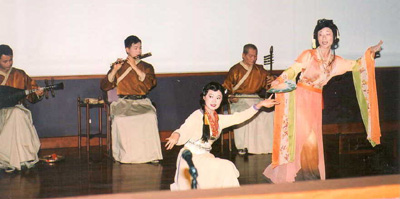
 One of Taiwan's best known and most critically acclaimed nanguan ensembles, the "Gang-a-tsui Theater," performed music and operas from the 12th century at two venues in the Washington D.C. area recently as part of the Taiwanese American Heritage Week celebrations.
The performances, at the Mormon Temple in Kensington, MD, on May 15, and at Taiwan's historic Twin Oaks estate on May 17, were part of the troupe's first-ever tour of the United States which included sold-out performances in Dallas, Houston, New Orleans, and New York.
A traditional nanguan ensemble consists of five instruments, a pipa (Chinese lute) and sanxian (three-stringed plucked long-neck lute), which play the melody, a dongxiao (vertical end-blown flute) and an erxian (Chinese vertical fiddle), that add ornamentation, and finally a paiban (five-slab wooden clapper) to keep the rhythm.
Nanguan opera originated in the city of Quanzhou in the coastal province of Fujian, and is sung in the Fujian dialect which is spoken by many people in Taiwan.
The Gang-a-tsui's Theater opened its performance in Washington, D.C. with a set featuring yajiao gu (southern drum or foot drum). By shifting the position and pressure of the foot on the drum, the musician can produce a range of different tones.
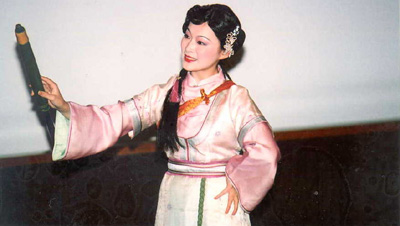 Gang-a-tsui Theater and its nanguan ensemble were founded in 1993 by Chou Yih-chang, the company's director, with the aim of reviving the traditional art of nanguan music and opera, but the group also likes to experiment with new concepts and practices as a way of connecting with modern audiences.
The company has performed extensively in Taiwan and around the world. In 1999, it was invited to perform in Mexico at the first International Festival of Traditional Dance. In May 2001 the troupe performed at Tokyo's Kioi Hall as well as at Osaka's National Museum of Ethnology, and in July 2002 the group won acclaim for their performance of music and opera at the newly renovated Lin family mansion and garden in the Taipei suburb of Panchiao.
