

A major territorial dispute is brewing in the East China Sea.
As one of the founders of the United Nations, the Republic of China (Taiwan) believes it has the responsibility to resolve the dispute in a peaceful manner under the principles of the U.N. Charter. We are committed to the peaceful resolution because at the heart of the dispute are islands that belong to Taiwan.
These islands are known as the Diaoyutai Islands, which means "fishing platform" in Chinese. We see the islands as more than a platform for fishing; we also see them as a platform for peacemaking.
On September 26, 2012, Japanese Prime Minister Yoshihiko Noda delivered a speech at the United Nations, during which he proclaimed to the world "no dispute exists." This is truly regrettable since the rest of the world sees a major dispute—one with potentially grave consequences to regional peace and economic prosperity. Unless the relevant parties recognize that a dispute does indeed exist, a resolution cannot possibly be reached.
Prime Minister Noda also called for “stronger rule of law” to resolve territorial disputes, yet he rejected our proposal to submit the dispute to the International Court of Justice. He added that “any attempt to realize a country's claim by force or threat is inconsistent with the spirit of the U.N. Charter,” but continues to obfuscate the fact that Japan annexed the islands on January 14, 1895, amid the ongoing Sino-Japanese War (August 1894‒April 1895).
The Republic of China (Taiwan) cherishes the close friendship with Japan over the past sixty years. However, since Japan instigated the recent flare up, we urge the Japanese government to take responsible steps toward recognizing and resolving the dispute.
We have carefully reviewed Japan's sovereignty claims regarding the Diaoyutai Islands and we cannot agree with them. To summarize our position, we have laid out 10 points. We believe it is important to set the record straight and let the facts speak for themselves.
OUR SOVEREIGNTY CLAIM
1. The Diaoyutai Islands were first discovered, named, and used by Ming China (1368–1644).
• In the 15th century, the Chinese discovered the islands and named them Diaoyutai (Fishing Platform), Huangwei (Yellow Tail), and Chiwei (Red Tail), demonstrating intimate knowledge of the rich fishing resources in nearby waters later used by Taiwan fishermen.
• Chinese used them as navigation posts en route to Ryukyu Kingdom (now Okinawa).
• The islands were incorporated into Ming China’s coastal defense system.
2. The Diaoyutai Islands, along with Taiwan, became the territory of Qing China (1644-1912).
• Chinese envoy mission records described the islands as within the “border that separates Chinese and foreign lands.”
• Taiwan gazetteers recorded “Diaoyu Island can accommodates ten or more large ships” and placed it under Kavalan (Ilan) County, Taiwan. For example, Revised Gazetteer of Taiwan Prefecture (1747), Subsequent Revision of the Gazetteer of Taiwan Prefecture (1764), Gazetteer of Kavalan County (1852), Pictorial Treatise of Taiwan Proper (1872).
• These official records demonstrate Qing China’s long and continuous effective administration over the islands as part of Taiwan.
3. The Diaoyutai Islands were secretly annexed by Meiji Japan on January 14, 1895, during the Sino-Japanese War (August 1894~April 1895).
• Today, the Japanese government asserts: “From 1885 on, it repeatedly conducted on-site surveys which confirmed that the islands were uninhabited and there were no signs of control by the Qing Empire. It therefore made a Cabinet Decision on January 14 1895 to formally incorporate the islands.”
• However, old Meiji period documents unearthed from Japanese archives demonstrate that the Meiji government acknowledged Chinese ownership of the islands in 1885.
• In October 1885, following the first onsite investigation, Foreign Minister Inoue Kaoru and Foreign Ministry Public Communications Director Asada Tokunori described the islands as “close to the Chinese border... next to Taiwan and belonging to China” and “at this time, if we were to publicly place national markers, this must necessarily invite China’s suspicion.…”
• In November 1885, Okinawa Magistrate Nishimura Sutezo confirmed “since this matter is not unrelated to China, if problems do arise I would be in grave repentance for my responsibility”.
• Ten years later, in May 1895, Okinawa Governor Narahara Shigeru wrote to the Home Ministry confirming no investigations of the islands took place since 1885.
• In August 1894, the Sino-Japanese War broke out. On September 17, Japan defeated China’s Beiyang Naval Fleet. On October 24, Japan crossed the Yalu River and invaded China. By November 21, Japan captured the Chinese city Port Arthur.
• In December 1894, the Japanese Home Ministry stated that the incorporation of the disputed islands “involved negotiations with China… but the situation today is greatly different from back then.”
• Japan accordingly incorporated the islands secretly based on a cabinet decision of January 14, 1895 amid the ongoing war. The cabinet decision was marked “Confidential” and, contrary to established convention, was never publicly announced.
4. China ceded “Taiwan and its appertaining islands" to Japan in 1895.
• Following China's defeat in the Sino-Japanese War, Qing China was forced to sign the Treaty of Shimonoseki on April 17, 1895, which ceded "Taiwan and its appertaining islands" to Japan.
• Since the Diaoyutai Islands were part of Taiwan, the only basis of Japan’s legal rights is the 1895 Treaty of Shimonoseki, which was nullified after WWII.
5. Post WWII arrangements restored the islands to their pre-1895 legal status.
• The 1943 Cairo Declaration stipulated “all the territories Japan has stolen from the Chinese, such as Manchuria, Formosa (Taiwan), and the Pescadores, shall be restored to the Republic of China. Japan will also be expelled from all other territories which she has taken by violence and greed.”
• The 1945 Potsdam Proclamation stated, “…terms of the Cairo Declaration shall be carried out...”
• The 1945 Japanese Instrument of Surrender accepted the terms of the Potsdam Proclamation.
• All three international legal documents remain legally binding on the respective countries today, including the U.S., Japan and the R.O.C. (Taiwan).
6. The Diaoyutai Islands, when secretly annexed by Japan in 1895, were placed under Okinawa and later renamed.
• Japan annexed the islands and placed them administratively under Okinawa in 1895 and formally renamed them "Senkaku Islands" in 1900.
• These unilateral acts masked the islands' original Chinese ownership and identity, which resulted in their omission from the post-WWII arrangements as described in (5).
• When Japan returned Taiwan to the R.O.C., both sides adopted the 1945 administrative arrangement of Taiwan, with the Allied Powers (including the R.O.C.) unaware that the uninhabited “Senkaku Islands” were in fact the former Diaoyutai Islands.
7. The Republic of China (Taiwan) never recognized Japanese sovereignty over the islands after WWII.
• The Diaoyutai Islands, per the mistakes described in (6), were placed under U.S. trusteeship according to Article III of the 1951 San Francisco Peace Treaty, which the R.O.C. (Taiwan) was not invited to sign.
• The 1952 Sino-Japanese Peace Treaty signed in Taipei between R.O.C. (Taiwan) and Japan did not include references to Article III of the San Francisco Peace Treaty.
8. From 1945-1971, the Diaoyutai Islands were under the administration of the U.S., not Japan.
• Thus, Japan's claim that it has administered the islands for over a century is misstating the facts.
• Prior to 1971, Taiwan did not lodge protests to the Japanese government because the islands were under U.S., not Japanese, administration.
9. The U.S. did not transfer the islands’ sovereignty to Japan in 1972.
• Since 1971, the U.S. has reiterated that the transferring of administrative rights of these islands to Japan does not constitute a transfer of sovereignty.
• The U.S. has maintained a policy of neutrality and has reiterated that it does not take a position on the ultimate sovereignty of these islands.
10. Japan’s sovereignty claim over the Diaoyutai Islands is invalid
ab initio (from the onset) under international law.
• Ex injuria jus non oritur (a legal right or entitlement cannot arise from an unlawful act or omission) is a general principle of international law recognized by civilized nations.
• Japan’s claim of sovereignty over the Diaoyutai Islands is invalid ab initio (from the onset) under international law since the islands were never terra nullius (land without owner).
OUR PROPOSAL: THE EAST CHINA SEA PEACE INITIATIVE
The resolution of the sovereignty issue will take time, but there are steps we can take immediately to reduce tension and foster peace.
Peaceful resolution of disputes is generally achieved in one of the four ways: negotiation, mediation, arbitration, and litigation. These approaches are not necessarily mutually exclusive, but must all begin with negotiation.
On August 5, 2012, Republic of China President Ma Ying-jeou proposed a two-stage East China Sea Peace Initiative based on the concept that while sovereignty is indivisible, resources can be shared. Therefore, the Peace Initiative calls upon the parties concerned to replace confrontation with dialogue, shelve territorial disputes through negotiations, formulate a Code of Conduct in the East China Sea and engage in joint development of resources.
STAGE 1: Shelve territorial disputes through meaningful dialogue
STAGE 2: Share resources through joint development
Key Issues:
• East China Sea code of conduct
• Joint conservation and management of the East China Sea’s living resources
• Joint exploration and exploitation of the East China Sea’s non-living resources
• Joint marine scientific research & protection of the marine environment
• Joint exercises to maintain conventional and unconventional security in the East China Sea
Over the long run, we can move from three parallel tracks of bilateral dialogue (between Taiwan and Japan, Taiwan and the Chinese mainland, and Japan and the mainland) to one track of trilateral negotiations.
We sincerely hope the U.S. government and its people will support this peace initiative.
Picture Captions:
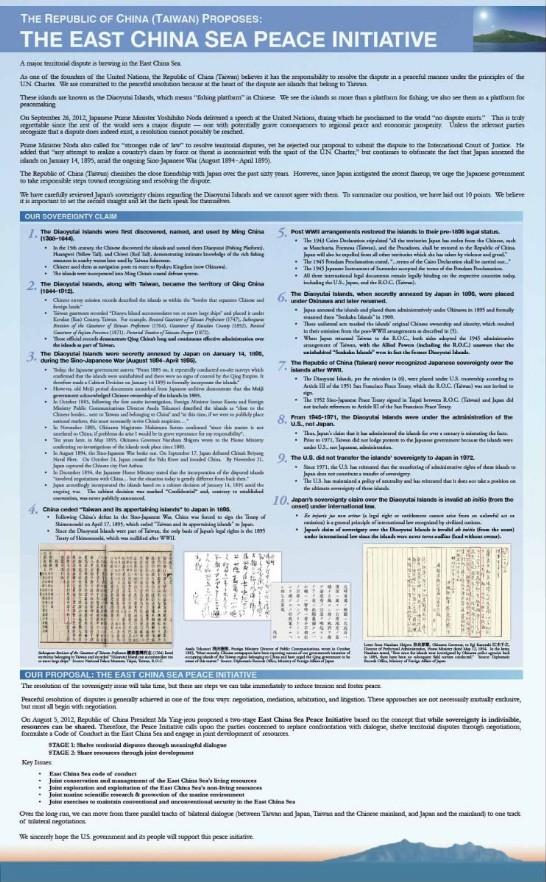
Subsequent Revision of the Gazetteer of Taiwan Prefecture (續修臺灣府志) (1764) listed territories belonging to Taiwan and recorded “Diaoyutai Island can accommodate ten or more large ships.” Source: National Palace Museum, Taipei, Taiwan
Asada Tokunori (浅田徳則), Foreign Ministry Director of Public Communications, wrote in October 1885, “Most recently, Chinese newspapers have been reporting rumors of our government’s intention of occupying islands of the Taiwan region belonging to China and have urged the Qing government to be aware of this matter.” Source: Diplomatic Records Office, Ministry of Foreign Affairs of Japan
Letter from Narahara Shigeru (奈良原繁), Okinawa Governor, to Egi Kazuyaki (江木千之), Director of Prefectural Administration, Home Ministry dated May 12, 1894. In the letter, Narahara stated, “Ever since the islands were investigated by Okinawa police agencies back in 1885, there have been no subsequent field surveys conducted.” Source: Diplomatic Records Office, Ministry of Foreign Affairs of Japan.
