

Byline:EDWARD HSIEH Publication Date:01/01/2013
Creative thinking needed for ROC to leverage South China Sea quandary
One would be hard-pressed not to notice the recent wave of sovereignty disputes in the South China Sea, with tensions rising in the region as a whole as countries advance competing territorial claims. As these rival claims are pressed, a general feeling of nervousness pervades the Asia-Pacific. Given this state of affairs, Taiwan is in the unenviable position of not only being a fellow claimant, but the only country that is functionally unable to engage in any negotiated solution due to the diplomatic blockade by China. As such, Taiwan is marginalized.
Without a doubt, the South China Sea has obvious strategic value, both in terms of defense and economics, so it does not seem likely that any claimants would readily drop their claims, especially at a time when the security dynamics of the region are being redrawn. The American pivot to Asia, for example, is seen by many regional actors as an opportunity to balance against a rising Middle Kingdom, while Beijing perceives the American return to Asia as a ploy to encircle or contain China.
On June 2, 2012, US Secretary of Defense Leon Panetta announced the pivot in a speech on the US rebalance toward the Asia-Pacific. After nearly a decade of focus on the Middle East, the United States realized its de-emphasis on Asia had permitted the rise of a militarily confident and newly aggressive China. The failure of Washington’s decades-long engagement strategy toward Beijing gave way to one closer to containment, with Beijing joining the competition with counter-containment efforts of its own.
According to Panetta, approximately 60 percent of the US fleet will be deployed in Asia by 2020, with a concomitant adjustment in the deployment of armed forces personnel and new strategic weapons to the Pacific. The new position will be evident in both military and economic terms through the biennial Rim of the Pacific (RIMPAC) exercise and such regional groupings as the Trans-Pacific Partnership (TPP). Countering this is a Chinese drive to extend the influence of the Shanghai Cooperation Organization (SCO) into the Middle East, hold large-scale military exercises of its own, and establish a new strategic ballistic-missile force and deploy high-tech jet fighters. The purpose is for Beijing to demonstrate its capabilities and determination to resist American encirclement.
Polarizing news
News of the American return to Asia has encouraged some Asian countries, notably the Philippines and Vietnam, to stand up to China and express their intent to press their littoral interests. Both countries agree on the need for a code of conduct in the South China Sea, and have taken a hard line to defend their claims from Chinese encroachment. Manila is relying on a promise of US support to defend its territory, while Japan, another staunch US ally, is defending its claim over the Scarborough Shoal. Vietnam, meanwhile, passed a law defining its territorial waters, including its Exclusive Economic Zone (EEZ) and continental shelf, in accordance with the 1982 United Nations Convention on the Law of the Sea. The legislation domestically affirms that the disputed islands in the Paracel and Spratly chains belong to Vietnam, and Hanoi has been executing high-profile patrols of the islands by jet fighter.
Reacting to these affronts to its core interests, China took a number of retaliatory actions. It exerted pressure on Cambodia, the host of the 45th ASEAN Foreign Ministers’ Meeting, to scuttle the issuance of the customary joint communiqué, marking the first time this has happened in the organization’s nearly half-century-long history.
In its conflict with Manila over the Scarborough Shoal (known as Huangyan Island in China and Panatag Shoal in the Philippines), Beijing attacked on the economic front, disallowing tourist trips to the Philippines, citing safety issues, and holding up banana imports for longer inspections, citing “quarantine concerns.”
To intimidate Vietnam, Beijing approved the July 24, 2012 establishment of Sansha city in Hainan province, to nominally administer the Spratly and Paracel Islands as well as the Macclesfield Bank, and it issued an open invitation for foreign oil bids in territory that falls within Vietnam’s EEZ.
Despite the Republic of China (ROC) being forced to withdraw from mainland China in 1949, the occupation and management of its holdings in the South China Sea still lasted for a long time afterward. ROC historical archives show that, in 1964, then-President Chiang Kai-shek ordered Chen Cheng, then the chairman of the Joint Chiefs of Staff, to deploy troops to the Paracels and Spratlys. This suggests that the ROC not only occupied these islands at that time, but was in a position of effective management of them.
For complicated diplomatic, economic, and military reasons, the ROC government decided to keep only Taiping Island (or Itu Aba) and remove its forces from the others. While the reasons likely had to do with ROC sovereignty and to show good will to neighboring countries, this decision weakened the legitimacy of ROC claims over the islands, giving other powers a chance to occupy them and bolster their own claims. After the People’s Republic of China (PRC) assumed the ROC’s UN seat in 1971, and when the United States derecognized Taipei in favor of Beijing in 1979, much of the ROC’s place in the world has been assumed by the PRC.
Constrained international space
This trend is continuing: China’s rise continues unabated, and it is gaining more and more influence in the world even as friendly forces are becoming weaker in comparison. Beijing uses this influence to constrain the international space open to Taipei—a diplomatic blockade that is simply too hard to break through. This trend shows no signs of changing any time soon, leaving the ROC government hardly able to do anything about it, and giving the people of Taiwan a feeling of marginalization that grows day by day.
During the Cold War, Taiwan depended on geopolitical factors, such as its key geographic position in the First Island Chain, to become an integral part of Western containment efforts against communist expansion. But with the fall of the Berlin Wall and the rise of China, that situation changed, and the military value of Taiwan has decreased. Besides its vibrant democracy, the crucial factors in trilateral Taipei-Washington-Beijing relations will be how best to manifest military, semi-military and nonmilitary value.
Since 2008, Washington insiders have begun to hear a growing chorus from the “abandon Taiwan” movement, until last year when it became an issue fit for open discussion. Although it has not been reflected in mainstream policy in the United States, it has still been instrumental in illustrating just how far Taiwan’s strategic value, and the US willingness to take risks, have waned, even to the point of damaging US interests.
The arguments put forward by proponents of this movement follow simple, almost facile, logic. The first is that China is too strong: Because the United States cannot maintain balance in the Taiwan Strait indefinitely, and since Washington needs Beijing’s cooperation in international affairs, therefore the United States must sacrifice Taiwan in exchange for a promise of Chinese cooperation.
The second is to strengthen the United States: Even if China takes Taiwan, it still cannot challenge US dominance in Asia. In addition, since “the Taiwan issue” is often perceived as an irritant to Sino-US ties, abandoning Taiwan would not only remove that irritant but also placate China and put an end to its saber rattling.
The third proposes a Finlandization of Taiwan: If Taiwan is under effective Chinese suzerainty, then the United States can stop selling it high-tech weaponry, and effectively sever its security ties with the island.
Unilateral changes
Clearly, following a path dictated by any of these options would be detrimental to the survival of Taiwan’s democracy. It would abrogate the US position of opposing actions or statements, from either side, that would unilaterally alter Taiwan’s status. As a democracy, Taiwan must heed the will of its people in any development in the cross-strait relationship. This becomes increasingly difficult as talk like that described above makes it seem as though Taiwan is a chess piece being moved about the board by the great powers. It therefore becomes incumbent upon Taipei to somehow find a voice in the international community from which it has largely been excluded.
The contentious nature of the conflicting South China Sea disputes could give Taiwan that voice, especially as it coincides with the United States re-engaging in Asia. This could once again be accomplished through the geopolitical lens.
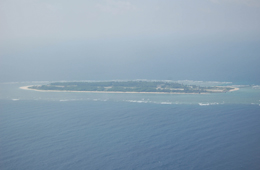
The largest island in the Spratly island chain—and the only one with its own source of fresh water—is Itu Aba, or Taiping Island. This highly prized territory is claimed by the Philippines, China, and Vietnam, but it is under the effective administration of Taiwan, with 600 Taiwanese living there, mostly Coast Guard personnel. This holding could conceivably be leveraged as a possible way to engage at an official level with other regional powers.
Taiping has been developed by the ROC for many years, with a landing strip capable of accommodating C-130 transport planes, and even tourist attractions. A feasible strategy could include using the island as a staging area for humanitarian and search-and-rescue missions, and erecting a weather observation station which could provide information to all vessels transiting through the area. Further projects could conceivably include using the island in joint US-ROC intelligence-gathering efforts.
Such cooperation on the development of Taiping Island is a good way to enhance the lines of defense for the ROC national security. All these measures could not only enlarge the ROC’s contribution on the world stage, but it would also eliminate doubts in the United States about Taiwan’s importance as a willing ally in the region.
______________________________
Lieutenant Colonel Edward Hsieh is an instructor at National Defense University’s Army Command and Staff College.
Copyright © 2013 by Edward Hsieh
Picture: Taiping Island, the largest of the Nansha (Spratly) Islands, is administered by the ROC. About 600 Taiwanese, mostly Coast Guard personnel, live on the 0.49-square-kilometer island. (Central News Agency)
