

Byline:STEVEN CROOK Publication Date:02/01/2013
Taiwan’s homestay industry is becoming more professional and international in outlook.
When Charlies Liu (劉寧傳) quit his civil service job with the Kaohsiung City Government and returned to the place where he grew up so he could be with his ailing mother, he did not think he would soon be embarking on a new career in the tourism industry, and that within a decade he would have hosted visitors from more than 40 countries.
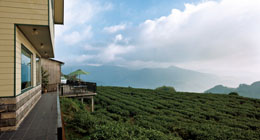
In November 2003, on land that has belonged to his family for more than 80 years, Liu opened Small Swiss Homestay, a lodging establishment with four rooms and mountain views. Located in a tea-growing district in Chiayi County, southern Taiwan, not far from Alishan National Forest Recreation Area, Small Swiss Homestay is in many ways a typical minsu, as bed-and-breakfast (B&B) establishments are known in Chinese.
Over the past decade, Taiwan’s tourism industry has transformed significantly. Perhaps few of the changes have enhanced the travel experience more than the proliferation of minsu. In these small lodges, guests can stay in a family-run establishment and enjoy a blend of informal hospitality, local knowledge and natural scenery that few hotels can match. Liu, for instance, takes many of his guests to Fenqihu, a nearby town famous for its quaint character, and Yushan National Park, where they can see Taiwan’s highest peak.
Until December 2001, when the Regulations for the Management of Home Stay Facilities were issued, minsu existed without a legal framework. The regulations define “a home stay facility” as “a lodging facility run as a family sideline business, using the spare rooms of a self-used residence to provide tourists with a rural living experience.” In practice, while many homestay businesses match these criteria closely, quite a number are purpose-built accommodations that provide the family’s main source of income. Most of these latter establishments are fairly modest, though, and retain the personalized service of a family-run business. The rules state that such operations should have “no more than five guest rooms, with a total floor area of no more than 150 square meters,” although local governments can authorize up to 15 rooms for homestays with “specific tourism features” such as those located on a tourist farm or in a remote area.
To be licensed, a B&B must satisfy fire safety rules and undergo inspections that check, among other things, whether each “guest room and bathroom [has] adequate ventilation and ... sufficient light,” according to the website of the Tourism Bureau under the Ministry of Transportation and Communications. Operators must purchase insurance, and cannot be individuals with convictions for drug, firearm-related, sexual or other serious criminal offenses.
Since the regulations came into force, the number of fully licensed establishments has been growing nonstop. According to statistics issued by the Tourism Bureau, new minsu registered with the authorities at a rate of more than one per day between 2004 and 2008.
“At the end of September 2012, the national total of legal B&Bs was 3,619,” says Chen Yu-chuan (陳煜川), director of the bureau’s Hotel Inspection and Supervision Center. This central government unit oversees Taiwan’s homestay industry, but local governments are responsible for day-to-day enforcement. “City and county governments do from time to time, in accordance with the provisions, carry out inspections of B&Bs,” Chen says, adding that violations, such as a lack of firefighting equipment, are dealt with as dictated by the law.
“The Tourism Bureau offers operators of legal B&Bs guidance so they can upgrade their services. The bureau has also held many business management classes, and granted money to local governments and industry associations so they can organize workshops,” Chen says.
From 2011 to 2012, 711 B&B operators attended training courses as part of the Taiwan Host scheme, a program organized by the bureau and the Taipei-based Chinese National Federation of Industries. The 323 businesses that eventually obtained the “B&B Taiwan Host Mark” are committed to the highest standards of hygiene and safety as well as what Chen calls “gracious and enthusiastic service.” The mark is valid for three years.
Trade organizations are also doing their bit to upgrade the industry. The Yilan County Homestay Association, which was founded in 2005 and represents more than 180 B&Bs in northeast Taiwan, offers its members training in marketing, housekeeping, photography and other skills. Under the heading of “crisis management,” B&B operators are taught how to handle consumer disputes, accidents and other unexpected events. Members, who each pay NT$2,000 (US$69) per year, also benefit from alliance marketing activities, some of which are subsidized by the Tourism Bureau. “The association attends at least four major travel fairs each year, in Taipei, Kuala Lumpur, Singapore and Hong Kong,” says Chris Kuo (郭哲均), the association’s chairman.
By the end of 2012, the number of guest rooms in Taiwan’s homestays was well more than 14,000, compared with 25,527 rooms available in the 108 international and tourist-class hotels recognized by the Tourism Bureau. All other hotels in Taiwan are overseen by local governments.
Homestays are not miniature hotels, however. Before he became a minsu operator, Kuo worked in a hotel for a year and a half. He says he has barely drawn on what he learned in that industry since he and his wife, Vivi Chen (陳珈合), took over The Dew Bed & Breakfast in 2009 from his mother-in-law, who set the place up in February 2002. The family now operates three B&Bs, The Dew, Happiness and Starry Sky, which are located in Yilan’s Luodong Township, less than 10 minutes’ drive from the National Center for Traditional Arts and Luodong’s famous night market.
Running the business is quite a family affair. “My mother-in-law is responsible for making breakfast. My father-in-law is in charge of answering the phone. Environmental conservation is my grandparents-in-law’s responsibility. Vivi and I are responsible for marketing. All of us are responsible for hosting our guests,” Kuo says.
“In my opinion and experience, the hotel industry is purely business, while a homestay is not,” Kuo says. “As a hotel employee, I had to follow rules set by the boss, and I had to pay attention to matters of cost when making any decision. But in my homestay, friendship is more important than making money. In fact, it’s the core value.”
Charlene Lee (李夏零), who runs La Casa in New Taipei City’s Sanzhi District, agrees. She says the key to running a successful homestay is “to love sharing everything—food, local culture and happiness—and to treat your guests like your family, from your heart.”
Lee opened La Casa, which has three guest rooms, in 2005. “I love the countryside more than Taipei City, so I quit my job and started this homestay,” she explains. When Lee bought the house with some friends, however, they did not plan to open a bed-and-breakfast. “We were simply thinking about loving the life here and sharing it with travelers,” she recalls. “We love happiness more than business.”
Taiwan’s homestays are concentrated on the island’s east coast. Yilan County is a hot spot, with more licensed minsu by September 2012—655 in all—than any other county, city or special municipality except neighboring Hualien County, which had 827, according to the Tourism Bureau. These two counties, plus central Taiwan’s Nantou County (488 legal minsu) and Taitung County (431) in eastern Taiwan, account for two-thirds of Taiwan’s registered homestays.
Kaohsiung, by contrast, has surprisingly few of the home-style accommodations. The special municipality in southern Taiwan has one-eighth of Taiwan’s population, but just 54 registered minsu. “The municipality is rich in tourism resources, and no part of it has too many B&B operations,” says Hsu Chuan-sheng (許傳盛), director-general of Kaohsiung City Government’s Tourism Bureau. Asked if any part of the city would particularly benefit by opening more homestays, Hsu names Tianliao District. This thinly populated district is famous for its strikingly barren, moonlike badlands, yet has just one B&B.
“Kaohsiung City Government attaches considerable importance to the B&B industry,” Hsu says. “B&Bs can be combined with local culture, natural landscapes, environmental resources and agriculture to provide in-depth experiences for travelers. They can also be integrated with other tourism resources to promote local economic development and create employment opportunities.”
More B&Bs, More Tourism
The city government has taken various steps to bolster the homestay industry. In November 2011, for instance, the city issued regulations allowing B&Bs of up to 15 rooms to operate legally. “In this way, B&Bs will be able to expand and provide more professional services, thus expanding the tourism industry,” Hsu says. “Also, this bureau’s Hotels and Homestays Hospitality Improvement Plan provides B&B owners with professional guidance so they can ... improve service quality.”
According to Hsu, the bureau is “committed to detecting illegal B&Bs so as to protect consumers, and to counsel such businesses so they can obtain a registration certificate, in order to enhance the quality of tourism in Kaohsiung.”
Estimates of how many unlicensed homestays are operating in Taiwan vary hugely. The Tourism Bureau’s Chen speaks of “about 438,” and says certain homestays cannot become licensed because they violate land-use controls, or because the buildings themselves are illegal constructions. Jason Yen (顏建賢), an associate professor in the Graduate Institute of Hospitality and Tourism Management at Jinwen University of Science and Technology, believes the total number of homestays in Taiwan is “above 10,000,” implying that illegal operations outnumber licensed establishments by a ratio of around 2:1.
In some places the ratio is even more skewed. On Xiaoliuqiu, a small island that is part of Pingtung County at the southern tip of Taiwan, “there are almost 110 homestays, but only 22 of them are legal,” says Maria Pan (潘翠萍), spokeswoman for the Dapeng Bay National Scenic Area Administration.
Kuo believes there are currently around 1,300 unlicensed B&Bs in Yilan County, and he is dissatisfied with the authorities’ attitude about these businesses. “The government is not very active,” he says. “In my opinion, the government should be more aggressive about finding and closing illegal homestays or trying to help them to get licenced, to protect legal homestays and tourists.”
Unlicensed B&Bs risk fines of between NT$30,000 (US$1,034) and NT$150,000 (US$5,172), and are excluded from government-sponsored marketing and training events. But in certain respects, Kuo says, legal homestays are actually at a disadvantage. “We have to pay tax, and because we’re licensed businesses, we have to pay more for utilities,” he says.
Despite those disadvantages, Chinbe No. 25 Guesthouse owner Sammi Chen (陳惠娟) says becoming a licensed operator is well worth it in the long run. “If you’re serious about the business, you’ll prepare everything before opening,” she says. “If you aren’t serious, it’ll definitely be reflected in your service and attitude, and of course people will notice it.” She adds that her homestay has been fully legal from its opening in August 2009.
Spur-of-the-Moment Move
Sammi Chen was inspired to open her B&B after a wonderful vacation in the place where she spent the first five years of her life—the Matsu islands, an archipelago 200 kilometers northwest of Taipei and less than 10 kilometers from mainland China’s coast. The guesthouse takes its name from Qinbi, a Matsu village famous for its stone houses. “Matsu is a unique and peaceful place, and after going back to Taipei, I couldn’t get it out of my head,” she recalls. “My work contract was coming to an end, so I made a spur-of-the-moment decision to move back alone and open a guesthouse in a building owned by my family.”
The Chinbe No. 25 owner says her background is an advantage. “I guess I can see Qinbi through my family’s eyes, but also I have an outsider’s view, which helps a lot when dealing with the balance between keeping a traditional building and running a modern guesthouse business.”
The guesthouse has been successful in spite of transportation difficulties that mean “flights and ferries are constantly canceled due to the weather,” she says. When it opened, Chinbi No. 25 had just three rooms. “We’ve recently rebuilt my father’s old workshop, and soon we’ll have 11 rooms,” Sammi Chen says. “Our occupancy rate is 20 percent between November and April, about 50 percent in May and June, and 70 percent from July to October.” According to homestay operators, a B&B that has a year-round occupancy rate above 20 percent is doing better than average.
The Matsu native’s success might be an exception, however, as Kuo says a number of homestays close down because the operators find being a minsu boss is not as easy as they expected. “Many people have a ‘homestay dream’ when they stay overnight in a homestay during their vacation. People always experience beautiful and romantic moments during their vacations, so they don’t know how much work goes into running a successful homestay. They don’t really understand how to operate one,” he explains. “They only focus on the ‘hardware’ [like buildings], but the most important thing about running a homestay is the ‘software’ [such as service and general ambience].”
According to Jinwen University of Science and Technology’s Yen, some owners decide it is simpler to share their rural retreats with friends only. Other homestays are forced to cease operations because buildings or access roads are damaged by typhoons.
On the outlying island group of Kinmen County, an archipelago just a few kilometers from mainland China’s Fujian province, local authorities recognize the importance of knowhow in running a successful homestay operation. Since 1999, Kinmen National Park Headquarters has overseen the restoration of 74 old residences in Shuitou, Qionglin and six other villages, and in 2005 it began making some of these available for use as B&Bs.
“After each renovation, the park holds an open tendering process. To win the right to manage a building, prospective managers need to make a detailed proposal,” says Lu Shu-fei (盧淑妃), the park’s deputy director and spokeswoman. “We want managers who are enthusiastic. We think this is the most important characteristic. Also, the management strategy, design or decoration described in the proposal should attract tourists.”
Potential managers need not be Kinmen residents. “But if they are residents of the village, we add two points to their proposals. For owners or owners’ children or grandchildren, we add four points,” Lu says. While previous experience running a homestay is not necessary, “some people will visit and learn from successful homestay managers before they submit their tender. We’ve found those who do this do the job well.”
Piece of History
The national park has spent about NT$560 million (US$19.31 million) on the restorations since 1999, money that has been invested to preserve the buildings, not to make a profit from the homestays, according to Lu. “There are more than 1,000 traditional houses in Kinmen National Park, and most were built using wood. The best way to preserve them is to have someone live in them to clean and maintain them,” she explains. “Not only does the park find people who can take care of these old residences, but visitors can also experience staying in a Southern Fujianese-style house,” she says of the scheme.
Lu says the system is unique. “The national park doesn’t rent these buildings from the owners, but rather signs a contract with each setting out that the park will pay 100 percent of renovation costs—the owners pay nothing—and in return can use the building for 30 years,” Lu explains. “As far as we know, no other place does this. Officials from counties in Taiwan have come here to learn from us.”
Malik Abidin, a Singaporean travel agent, was deeply impressed by Kinmen’s homestays when he spent two days in the archipelago in March 2012 as part of a familiarization tour of Taiwan. “I believe such places could become major attractions in their own right, just like ryokan are in Japan,” he says, referring to that country’s traditional inns. “The two I saw were exceptionally clean and had [all the conveniences], yet retained an abundance of character that’ll appeal to experienced travelers wanting to avoid the ‘same old, same old.’”
______________________________
Steven Crook is the author of Taiwan: The Bradt Travel Guide.
Picture 1: Small Swiss Homestay in Chiayi County, southern Taiwan. Informal hospitality and local knowledge set such guesthouses apart from most hotels. (Photo by Rich Matheson)
Picture 2: Yilan County’s Happiness B&B, one of three guesthouses operated by Chris Kuo and his family. While each family member has a specific duty in running the business, “all of us are responsible for hosting our guests,” he says. (Photo Courtesy of Chris Kuo)
Picture 3: Charlene Lee, center, owns La Casa in New Taipei City. Lee says the key to a good homestay is “to treat guests from your heart.” (Photo Courtesy of Charlene Lee)
Picture 4: Chinbe No. 25 Guesthouse was created after owner Sammi Chen spent a happy vacation in the place she grew up, Qinbi Village in the Matsu islands. (Photo Courtesy of Sammi Chen)
Picture 5: A traditional house in Kinmen County and after restoration by the Kinmen National Park Headquarters. A number of such buildings are now run as guesthouses. (Photo Courtesy of Li Ming-yi, Kinmen National Park Headquarters)
Picture 6: Kaohsiung City Government sees supporting homestay operators as a way to expand the tourism industry. Despite the striking scenery at the city’s Tianliao Moon World, for example, the area has just one B&B. (Photo by Hsueh Chi-kuang)
